📖
Opening Shelf & Fetching Catalog...
Connecting to For The Truth theological registry...
Connecting to For The Truth theological registry...
Please Contact us if you want to get the whole set!
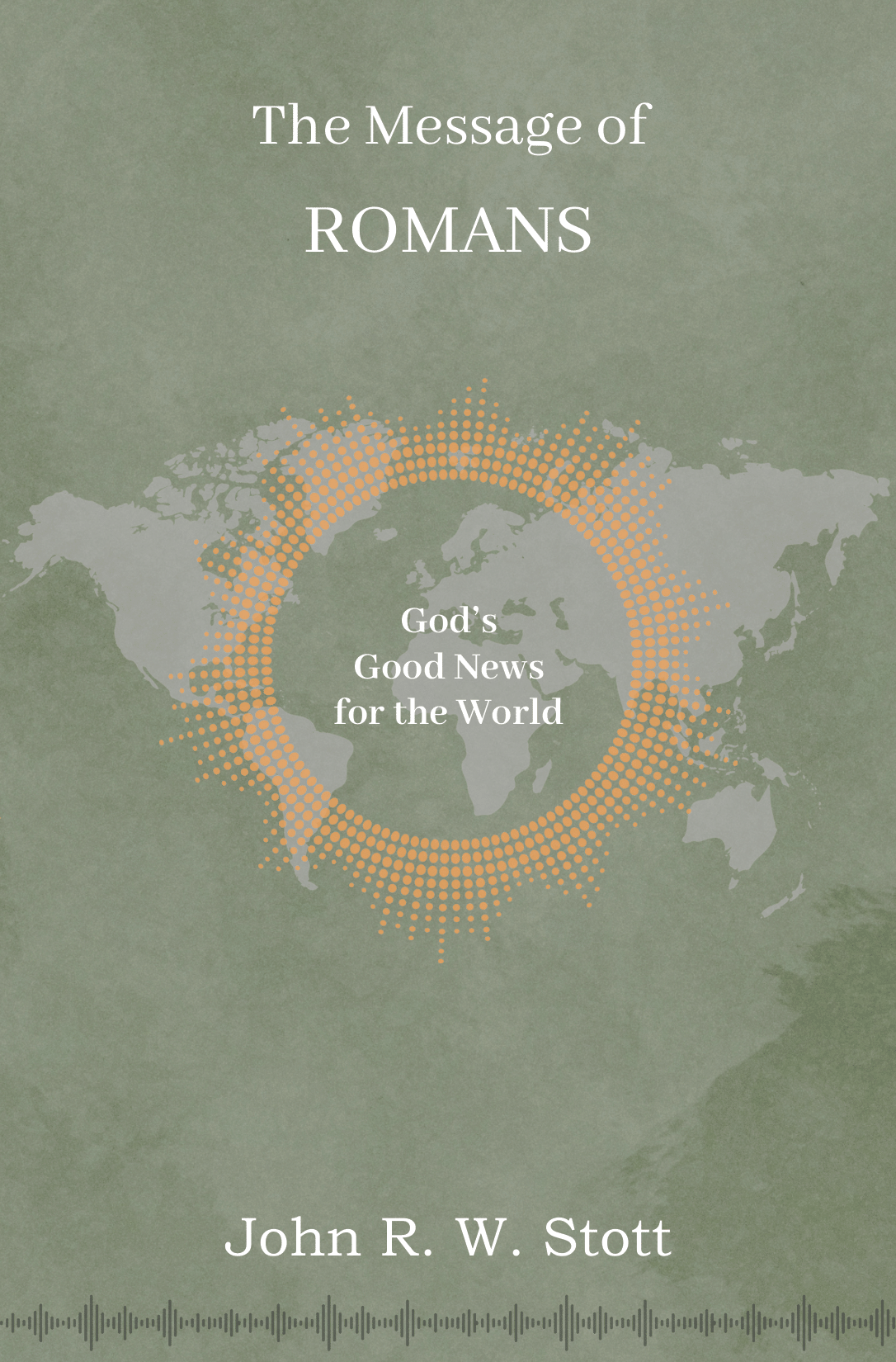
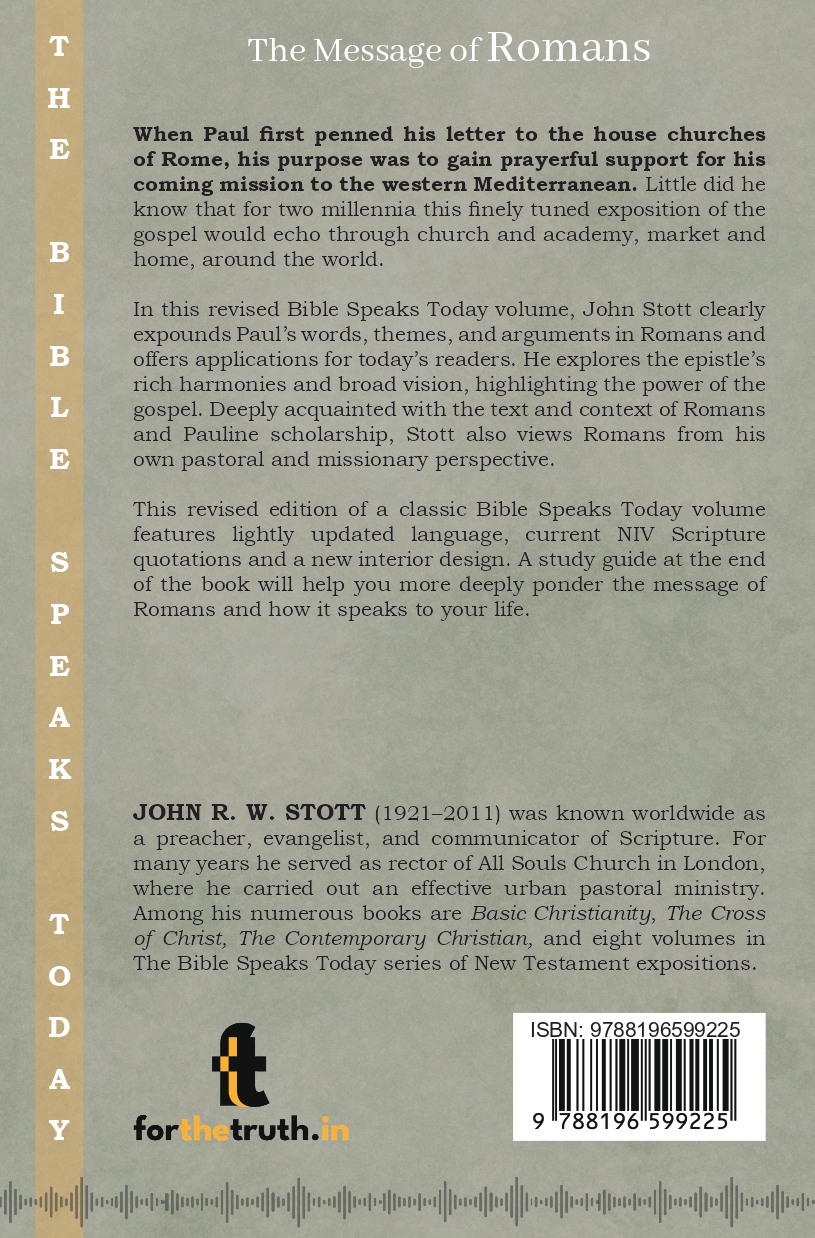
In this revised Bible Speaks Today volume, John Stott provides a clear exposition of Paul’s letter to the Romans, highlighting its timeless impact and practical applications for modern readers.
Part of the Bible Speaks Today Commentaries Series
EMI from ₹54/month
Pay later available

When Paul wrote to the house churches of Rome sometime around AD 57, he was writing a practical letter with a missionary purpose — he wanted their prayers and support for his planned mission to Spain. He could not have known that he was producing what many consider the greatest theological document ever written: a letter that would ignite the Protestant Reformation, transform the ministry of John Wesley, shape the missionary vision of William Carey, and continue to overturn lives and minds in every generation since.
No book of the Bible has had a more explosive impact on the history of Christianity than the letter to the Romans. And no commentary on Romans better combines scholarly depth, pastoral wisdom, and readable accessibility than John Stott's The Message of Romans.
This is, by Stott's own account, the most personally rooted of all his expositions — a letter he returned to again and again throughout his Christian life, finding new riches with every visit. Readers who spend time in this commentary will quickly understand why.
Romans is Paul's most sustained and comprehensive statement of the gospel. Unlike his other letters, which were largely written in response to specific problems in particular churches, Romans is a carefully structured, deliberately argued theological exposition — a Christian manifesto, as Stott calls it — setting out the scope and power of the good news of Jesus Christ.
The letter moves from the universal human condition under God's wrath (chapters 1–3), through the glorious announcement of justification by faith alone (chapters 3–5), into the liberating reality of life in the Spirit (chapters 6–8), before pausing to wrestle with the deeply painful question of Israel's place in God's plan of salvation (chapters 9–11). It then closes with a rich and practical vision of what transformed relationships look like in the body of Christ and in the wider world (chapters 12–15).
John Stott moves through all of this with the precision of a careful exegete, the warmth of a devoted pastor, and the breadth of a man who has spent a lifetime thinking about both the text of Romans and its implications for the church and world. He engages with Pauline scholarship without being enslaved to it, and he never loses sight of the pastoral and missionary dimensions of Paul's argument.
This revised edition is the most accessible version of Stott's commentary to date — thoroughly rooted in the original, lightly updated for today's reader, and equipped with a study guide that makes it as useful for a small group as it is for a preacher's study.
The Power of the Gospel Romans opens with one of the most electrifying statements in all of Scripture: Paul is not ashamed of the gospel, for it is the power of God for salvation for all who believe. Stott unpacks what Paul means by "power," by "gospel," and by "salvation" — and why this claim is as countercultural today as it was in first-century Rome.
The Universal Condition: Sin and the Wrath of God Before Paul can announce the good news, he must establish the bad news. Romans 1–3 is a relentless exposure of the human condition — not just the immorality of the pagan world, but the self-righteousness of the religious world and, above all, the just wrath of a holy God against all human sin. Stott handles this difficult but essential section with both boldness and pastoral care.
Justification by Faith Alone Romans 3–5 contains the most concentrated exposition of the doctrine of justification anywhere in Scripture. Paul argues that sinful human beings can be declared righteous before a holy God — not through their own moral performance or religious observance, but through faith in Jesus Christ, who bore their condemnation in their place. Stott traces Paul's argument with great care, showing why this doctrine is not merely a theological technicality but the very hinge on which the whole gospel turns.
Life in the Spirit: Romans 6–8 Having established the basis of salvation, Paul turns to its implications for daily life. Romans 6 addresses the relationship between grace and holiness. Romans 7 wrestles honestly with the ongoing experience of moral struggle. Romans 8 — widely regarded as one of the most glorious chapters in all of Scripture — opens up the life of the Spirit, the assurance of adoption as God's children, the groaning of creation, and the unbreakable security of those who are in Christ. Stott gives all three chapters careful, extended, and rich attention.
Israel, the Gentiles, and the Sovereignty of God: Romans 9–11 Perhaps the most theologically demanding section of Romans, chapters 9–11 address the apparent contradiction between God's promises to Israel and Israel's rejection of her Messiah. Stott engages honestly with election, predestination, and the mystery of God's sovereign purposes in salvation history, bringing both theological clarity and appropriate humility to one of the Bible's most debated passages.
The Transformed Life: Romans 12–15 The final section of Romans is a vision of what the gospel produces in human beings and communities. Paul calls for living sacrifices, transformed minds, humble service in the body of Christ, love for enemies, submission to governing authorities, and sensitivity to weaker consciences. Stott draws out the practical, social, and ecclesiastical implications of the gospel with his characteristic combination of biblical fidelity and contemporary relevance.
Romans as a Christian Manifesto for Today Throughout the commentary, Stott reads Romans as a document addressed not merely to first-century Rome but to every generation. He sees in Paul's vision of the gospel a freedom that overcomes ethnic conflict, the darkness of moral guilt, condemnation before God, and alienation from others — freedom to serve God and neighbours in love. This is a reading of Romans that speaks with urgency to our fractured and searching world.
The Message of Romans is one of the most important Bible commentaries a Christian can own. It is especially well suited for:
This is also one of the most significant Christian books you could give to an intellectually curious friend exploring the faith — or to any believer ready to go deeper.
John Robert Walmsley Stott was one of the most influential Christian leaders of the twentieth century. Billy Graham called him "the most respected clergyman in the world today," and biographer John Pollock described him as "the theological leader of world evangelicalism." Born in London in 1921 and educated at Rugby School and Cambridge, he was ordained into the Anglican ministry and served All Souls Church, Langham Place, London, for more than sixty years — as curate, rector, and rector emeritus — declining multiple invitations to become a bishop, archbishop, or college principal in order to remain a pastor, preacher, and Bible teacher.
He was a principal framer of the Lausanne Covenant (1974), one of the defining documents of global evangelical mission. He founded the Langham Partnership International, which has trained thousands of church leaders in over 100 countries. He was awarded the Lambeth Doctor of Divinity by the Archbishop of Canterbury in 1983. He wrote more than 50 books, translated into at least 65 languages, including Basic Christianity, The Cross of Christ, Issues Facing Christians Today, and The Contemporary Christian.
He served as New Testament editor of the Bible Speaks Today series and wrote eight volumes in it — The Message of Romans being, by his own account, the most personally meaningful of all.
He died in 2011 in his ninetieth year, having shaped the faith and ministry of pastors, scholars, and ordinary believers on every continent.
The Message of Romans is part of the internationally acclaimed Bible Speaks Today series, published by InterVarsity Press (IVP) and available in India through For The Truth.
John Stott was the New Testament editor of the Bible Speaks Today series — and The Message of Romans is perhaps his most celebrated contribution to it. Every volume in the series is built on three commitments:
Other John Stott volumes available at For The Truth include The Message of Acts, The Message of the Sermon on the Mount, The Message of Galatians, and The Message of 1 Timothy & Titus.
This revised edition of The Message of Romans includes: