📖
Opening Shelf & Fetching Catalog...
Connecting to For The Truth theological registry...
Connecting to For The Truth theological registry...
Please Contact us if you want to get the whole set!
“Paul emphasizes passing on gospel truth; Stott’s revised volume explores 1 Timothy and Titus, highlighting key themes.”
Part of the Bible Speaks Today Commentaries Series
EMI from ₹58/month
Pay later available

There is a moment in every ministry when the question of inheritance becomes urgent. Who will carry what I have been given? Who will guard the deposit? Who will ensure that the next generation receives, intact and undiminished, the gospel truth that has been entrusted to this one?
This is the question at the heart of Paul's letters to Timothy and Titus — letters written as the apostle neared the end of his life, when the churches he had planted were becoming established communities with their own leaders, their own challenges, and their own need for the kind of grounded, clear, practically wise guidance that would keep them faithful across the generations to come.
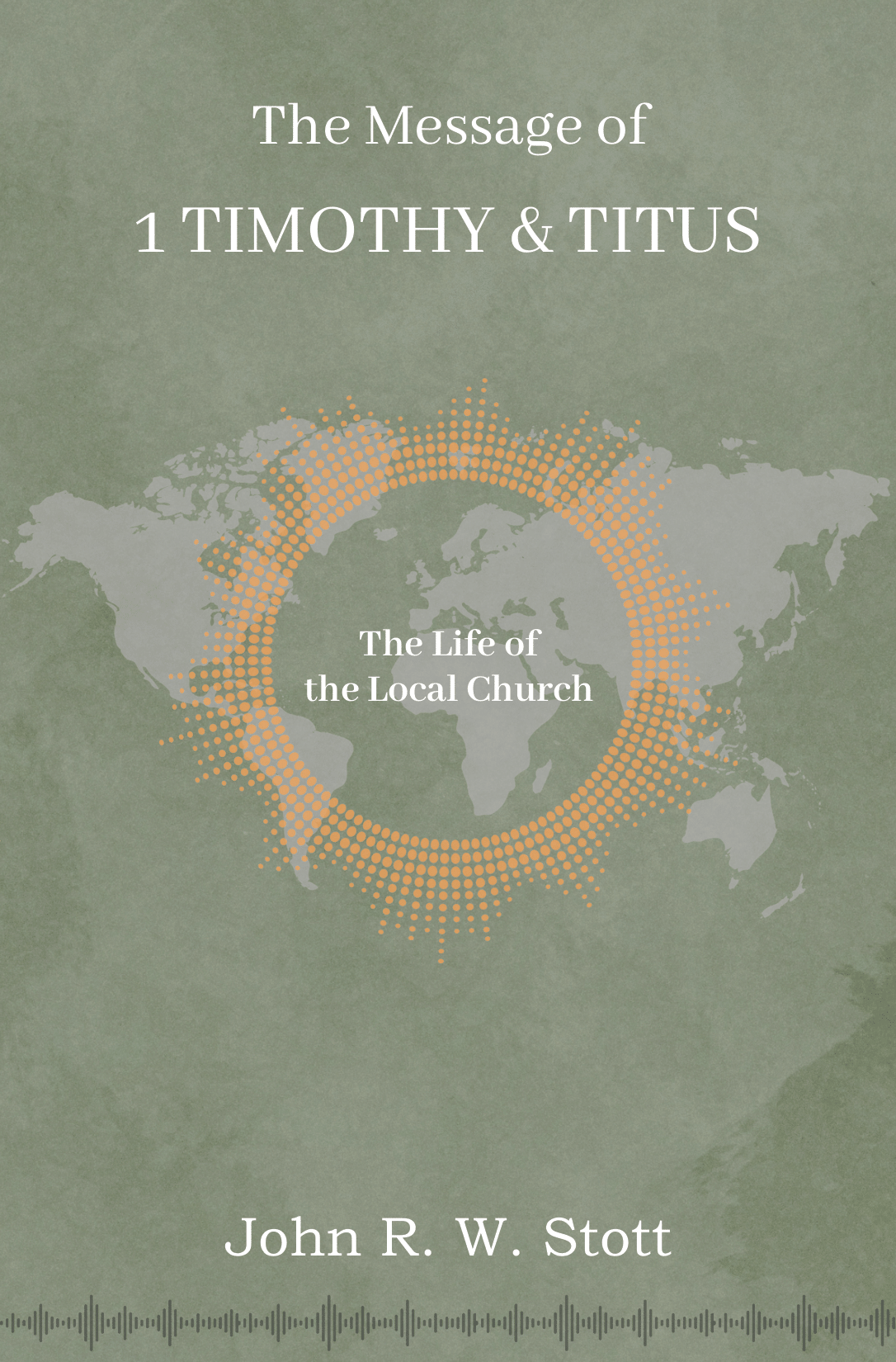
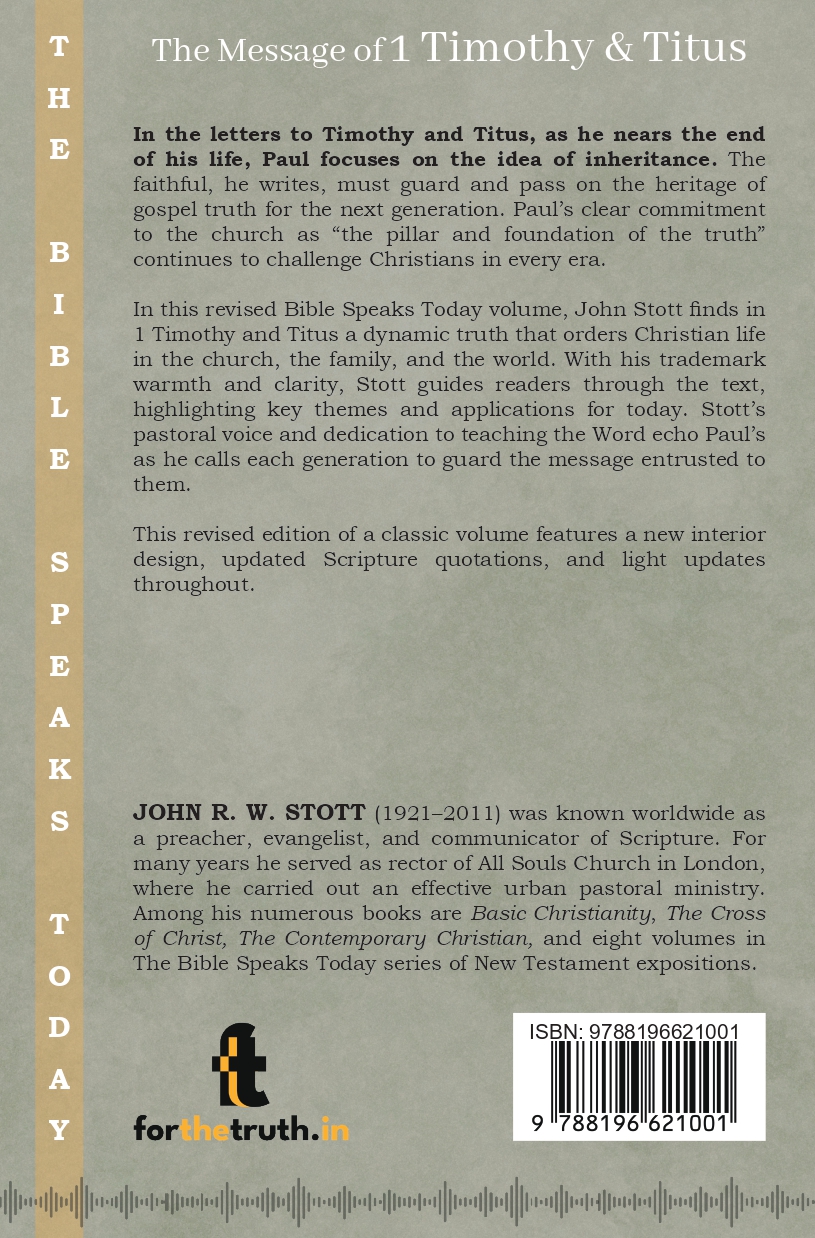
The Message of 1 Timothy & Titus by John Stott is the classic Bible Speaks Today exposition of these two Pastoral Epistles — now revised and refreshed with a new interior design, updated Scripture quotations, and light updates throughout. It brings Stott's trademark warmth, clarity, and pastoral care to two of the most practically important letters in the entire New Testament.
Paul's description of the church as the pillar and foundation of the truth (1 Timothy 3:15) is one of the most important and most demanding statements about the church's identity and calling in the entire New Testament. The church is not merely a community of believers, nor simply a gathering for worship. It is the institution that God has appointed to hold up and hold out the gospel truth — to be its guardian, its embodiment, and its herald in every generation.
John Stott builds his exposition of 1 Timothy around this conviction — showing how everything Paul says about church leadership, worship, doctrine, and community life flows from this foundational understanding of what the church is for. The church that knows it is the pillar and foundation of truth takes sound doctrine seriously, appoints qualified leaders carefully, conducts its worship with order and reverence, and disciplines itself to hold fast to the gospel across the passing of the years.
This understanding of the church is as urgently needed today as it was when Paul first wrote it — and Stott's exposition makes its implications for contemporary church life impossible to miss.
The letter of 1 Timothy is one of the most practically comprehensive treatments of church life in the New Testament. Paul addresses an extraordinary range of topics — prayer, the role of women in the church, the qualifications of elders and deacons, the handling of wealth, the care of widows, the treatment of older members, the dangers of false teaching, and the personal conduct of the minister of the gospel.
Stott works through this material with the careful, applicatory approach that has made his Bible Speaks Today volumes so trusted — grounding each section in its historical context, identifying the key principles at stake, and drawing out their implications for churches today. He is honest about the passages that generate genuine exegetical difficulty and genuine disagreement among careful interpreters — and he models the kind of thoughtful, Scripture-grounded engagement with those difficulties that helps readers think more clearly rather than simply adopting his conclusions.
Paul's letter to Titus, written to the co-worker he had left in Crete to appoint elders and set things in order, shares many of the same themes as 1 Timothy — sound doctrine, qualified leadership, the ordering of community life — but it approaches them from a different angle, with a distinctive emphasis on how the gospel of grace actually produces the transformation it promises.
The letter to Titus contains some of the most beautiful and theologically rich passages in the Pastoral Epistles — the great summary of the gospel in Titus 2:11–14, with its description of the grace that appeared and trains us to renounce ungodliness and live self-controlled, upright, and godly lives; and the account of regeneration and renewal in Titus 3:4–7, with its language of mercy, washing, and the Holy Spirit poured out through Jesus Christ our Saviour.
Stott opens these passages with the delight and care of someone who knows that here, as much as anywhere in the Pauline letters, the gospel is doing its most characteristic work — showing how the grace that saves also transforms, and how the community of the transformed is what the church is called to be.
John Stott identifies the unifying theme running through both letters as inheritance — the faithful passing on of gospel truth from one generation to the next. Paul's clear commitment to this theme — his charge to Timothy to guard the deposit, his instruction to Titus to hold firm to the trustworthy message — challenges every generation of Christians to ask the question that the apostle himself was asking near the end of his life: are we guarding what has been entrusted to us? And are we passing it on?
This theme gives the commentary a pastoral urgency that goes beyond historical interest or academic analysis. The letters to Timothy and Titus are not merely first-century church manuals — they are documents addressed to a challenge that every generation of the church faces and that no generation can afford to neglect.
This revised edition of a classic Bible Speaks Today volume features:
These updates make one of the most valuable volumes in the Bible Speaks Today series fully available and fully useful to a new generation of pastors, teachers, and students.
John Stott (1921–2011) was one of the most influential evangelical Christians of the twentieth century — a preacher, author, and theologian whose ministry shaped the global church across six decades. He served as Rector of All Souls Langham Place in London, founded the Langham Partnership for global theological education, and was the primary architect of the Lausanne Covenant (1974). His Bible Speaks Today volumes are among the most widely trusted expository commentaries in evangelical Christianity. He was known above all for combining rigorous scholarship with pastoral warmth and genuine accessibility — qualities that make his treatment of the Pastoral Epistles both academically trustworthy and genuinely useful for every kind of reader, from the scholarly preacher to the individual Christian seeking to understand Paul's vision for the church.
The Message of 1 Timothy & Titus is part of the Bible Speaks Today series from InterVarsity Press — one of the most trusted and widely-used series of expository Bible commentaries available, founded by John Stott and spanning the entire Old and New Testaments. Each volume combines careful exposition with applicatory writing that makes serious Bible engagement accessible to preachers, teachers, and ordinary Christians. Other volumes in the series available through For The Truth include The Message of 1 & 2 Thessalonians by John Stott and The Message of Colossians & Philemon by Dick Lucas.