📖
Opening Shelf & Fetching Catalog...
Connecting to For The Truth theological registry...
Connecting to For The Truth theological registry...
Please Contact us if you want to get the whole set!
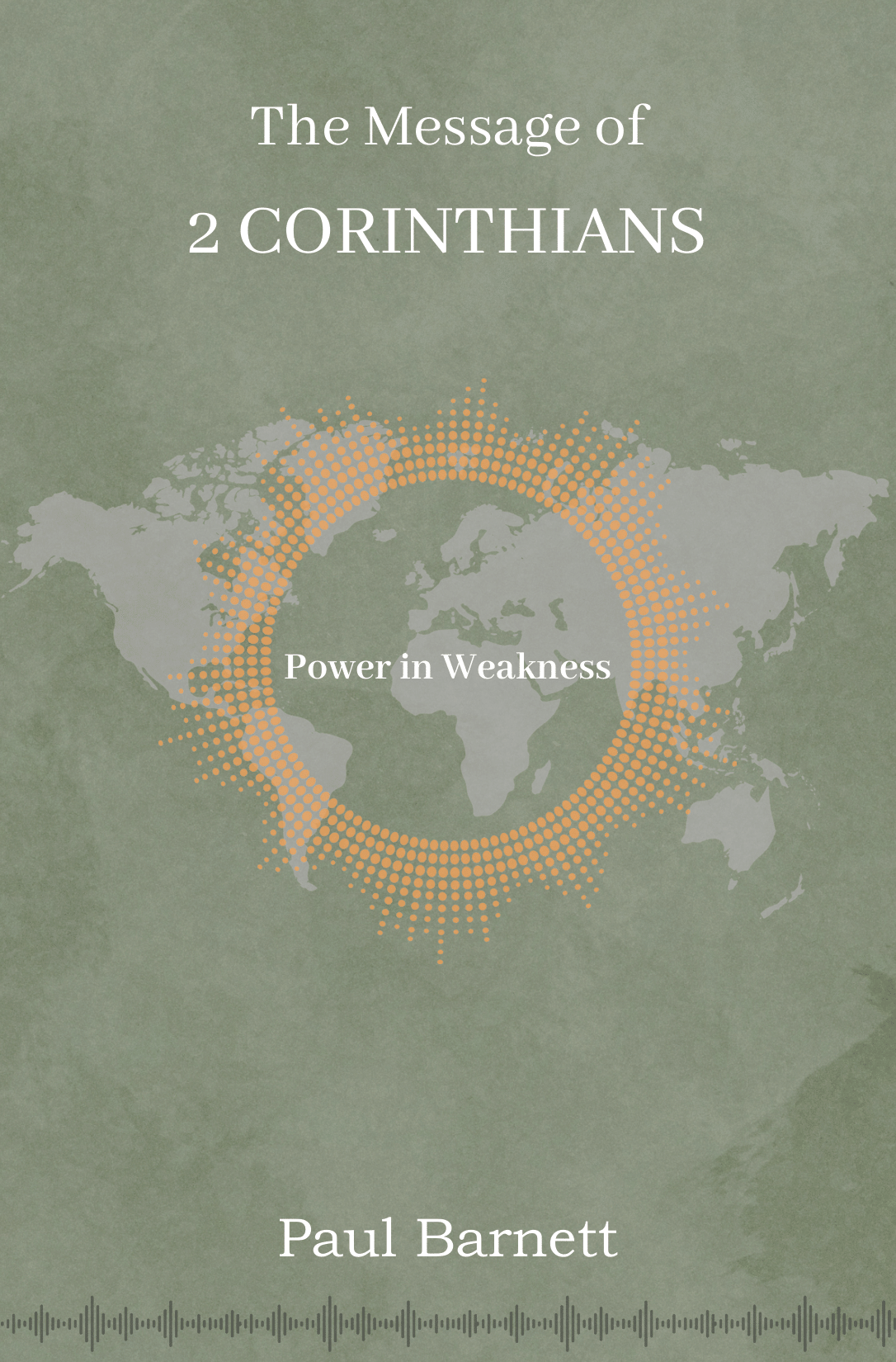
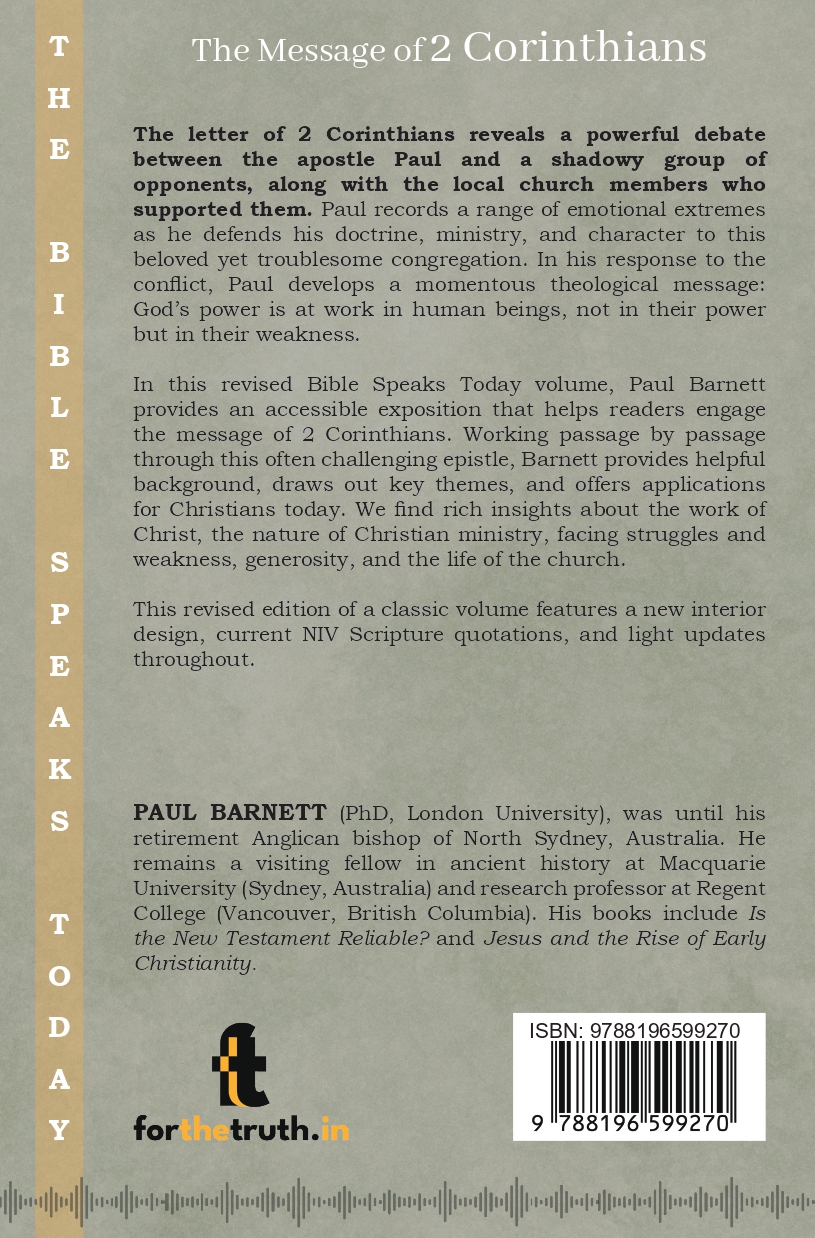
Revised Bible Speaks Today volume delves into the intense debate in 2 Corinthians, highlighting themes of God’s power in weakness, Christian ministry, and the life of the church.
Part of the Bible Speaks Today Commentaries Series
EMI from ₹54/month
Pay later available

If Romans is Paul at his most theological and 1 Corinthians at his most practical, then 2 Corinthians is Paul at his most personal. It is the letter in which the apostle is most transparent about his inner life — his joys and sorrows, his fears and confidence, his pain at rejection and his overwhelming love for a congregation that has wounded him deeply. It is also, paradoxically, the letter in which he articulates one of the most momentous theological truths of the entire New Testament: that God's power is made perfect in human weakness.
For any Christian who has ever felt inadequate for ministry, crushed by opposition, doubted whether the gospel is worth the cost — 2 Corinthians is the letter they need. And in The Message of 2 Corinthians, scholar, bishop, and Bible teacher Paul Barnett guides readers through this rich, intense, and often misunderstood epistle with clarity, depth, and genuine pastoral insight.
By the time Paul wrote 2 Corinthians, his relationship with the church at Corinth had become one of the most strained of his ministry. A group of opponents — compelling, apparently spiritual, and deeply persuasive — had come to Corinth and called into question everything about Paul: his authority, his credentials, his motives, even his physical presence and manner of speech. Some members of the church had sided with them. Paul's apostolic ministry was under direct attack.
His response is 2 Corinthians — the most emotionally charged of all his letters, swinging between tender affection and sharp rebuke, between soaring confidence and honest vulnerability. But running beneath all of these emotional extremes is a single, towering theological conviction: the gospel advances not through impressive human power but through apparent weakness, suffering, and foolishness — because that is precisely how God's power is most fully displayed.
Paul Barnett brings to this letter the credentials of both a careful scholar and an experienced church leader. Holding a PhD from London University and having served as Anglican Bishop of North Sydney, Australia, for more than a decade, he writes with the authority of one who understands both the academic debates surrounding this letter and the pastoral realities it addresses. His exposition moves through the text systematically, providing historical background, drawing out key themes, and offering thoughtful applications for Christian life and ministry today.
The Conflict Behind the Letter: Paul and His Opponents Understanding 2 Corinthians requires understanding its dramatic context. A group of opponents — sometimes called "super-apostles" — had infiltrated the Corinthian church with a version of ministry that prized outward impressiveness over cruciform faithfulness. Barnett traces this conflict carefully, showing how it shapes every section of the letter and why the debate between apparent strength and apparent weakness is still very much with the church today.
God's Power in Human Weakness The theological heartbeat of 2 Corinthians is the counterintuitive principle that Paul draws from his own experience of suffering, rejection, and infirmity: when he is weak, then he is strong — because the power of Christ rests on him. Barnett explores this theme in depth, drawing out its implications for how Christians understand suffering, failure, and the apparent frailty of gospel ministry.
The Ministry of the New Covenant At the centre of 2 Corinthians (chapters 2–7) lies one of Paul's greatest extended reflections on the nature of Christian ministry. He contrasts the old covenant of the letter — glorious but fading — with the new covenant of the Spirit, which surpasses it in glory. Ministers of the new covenant carry treasure in jars of clay precisely so that the surpassing greatness of the power might be from God and not from us. Barnett unpacks this passage with both exegetical care and pastoral richness.
The Thorn in the Flesh One of the most beloved and debated passages in 2 Corinthians — Paul's account of his thorn in the flesh and the Lord's response, "My grace is sufficient for you" (2 Corinthians 12:9) — receives careful attention. Barnett engages with the question of what the thorn was and, more importantly, what its theological purpose was: to keep Paul from becoming conceited and to channel God's power through human dependence.
The Ministry of Reconciliation 2 Corinthians 5 contains Paul's magnificent description of Christian ministry as the ministry of reconciliation. God was in Christ reconciling the world to himself, and has committed to us the message of reconciliation. Barnett draws out the christological depths of this passage and its implications for every Christian's understanding of their calling in the world.
Christian Generosity and the Grace of Giving Chapters 8 and 9 are Paul's extended appeal for the Corinthians to complete their contribution to the collection for the poor church in Jerusalem. Barnett shows how Paul frames this appeal not merely as a financial transaction but as an expression of the grace of God and a participation in the pattern of Christ's own self-giving generosity: he who was rich became poor so that through his poverty we might become rich.
Defending His Ministry and Apostolic Authority In the final chapters of 2 Corinthians, Paul is forced to do something deeply uncomfortable — to boast in order to defend his ministry against opponents who had undermined his credibility. He boasts, but in an unexpected register: in his weaknesses, his sufferings, his humiliations. Barnett shows how this unusual defence is itself a brilliant demonstration of the cross-shaped character of authentic Christian ministry.
The Message of 2 Corinthians is particularly valuable for:
Paul Barnett holds a PhD from London University and is one of Australia's most respected evangelical scholars and church leaders. He served as Anglican Bishop of North Sydney, Australia, from 1990 to 2001, and subsequently as a Visiting Fellow in Ancient History at Macquarie University in Sydney and Research Professor at Regent College in Vancouver, British Columbia.
He is a scholar of both early Christianity and the New Testament world, and his books reflect this dual commitment to rigorous historical research and accessible biblical exposition. His works include Is the New Testament Reliable?, Jesus and the Rise of Early Christianity, Behind the Scenes of the New Testament, and Jesus and the Logic of History, along with his major technical commentary on 2 Corinthians in the New International Commentary on the New Testament (NICNT) series published by Eerdmans.
In The Message of 2 Corinthians, Barnett brings all of these scholarly and pastoral resources to bear in a form accessible to any serious reader — a commentary that is grounded in the best of New Testament scholarship while remaining firmly oriented toward the needs of the church and the challenges of Christian living.
The Message of 2 Corinthians is part of the internationally acclaimed Bible Speaks Today series, published by InterVarsity Press (IVP) and available in India through For The Truth.
Every volume in the series is committed to three goals:
Other Pauline letters in the series available at For The Truth include The Message of 1 Corinthians (David Prior), The Message of Romans (John Stott), The Message of Galatians (John Stott), and The Message of Philippians.
This revised edition of The Message of 2 Corinthians includes: