📖
Opening Shelf & Fetching Catalog...
Connecting to For The Truth theological registry...
Connecting to For The Truth theological registry...
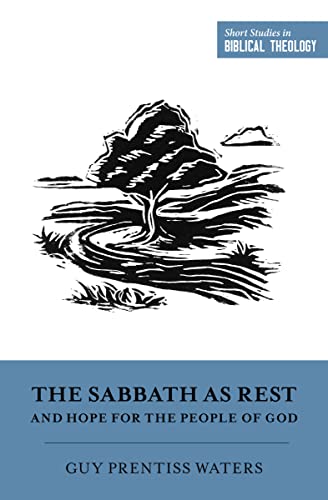
Part of the Short Studies in Biblical Theology Series
EMI from ₹42/month
Pay later available

Most Christians know that the Sabbath matters. They know that God rested on the seventh day, that he commanded Israel to observe it, and that it appears in the Ten Commandments. But what exactly does the Sabbath mean? Has it been fulfilled in Christ — or does it still bind Christians today? What does the New Testament say about it? And what does it have to do with the ultimate hope of the people of God?
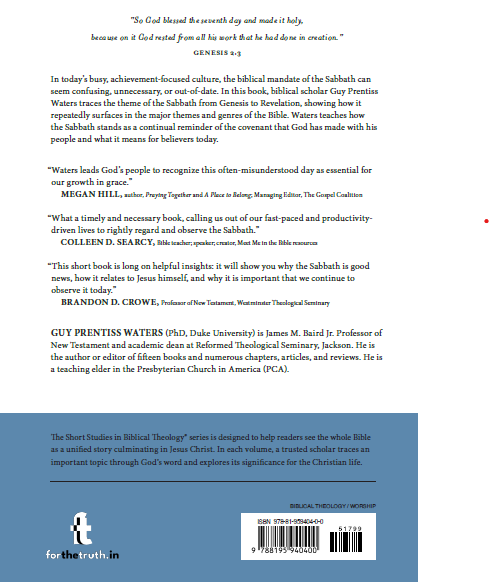
These are not easy questions. The Sabbath is one of the most debated and most misunderstood subjects in biblical theology — generating disagreement not just between Christians and the wider culture but within the church itself. And yet, as Guy Prentiss Waters shows in this concise and carefully argued study, the Sabbath is also one of the most rich and hope-giving themes in the entire Bible — a thread that runs from the creation of the world to the consummation of all things, reminding God's people at every point of both the rest that God provides and the rest that is still to come.
The Sabbath as Rest and Hope for the People of God is part of the Short Studies in Biblical Theology series from Crossway — a collection of brief, accessible, and academically rigorous studies in the major themes of Scripture. Waters brings his gifts as a careful biblical scholar and Reformed theologian to an introductory study that is both comprehensive in its canonical sweep and accessible in its presentation.
He organises the study around the major stages and genres of biblical revelation, tracing the Sabbath theme through each:
Creation — the foundation of the Sabbath The Sabbath does not begin with Moses. It begins with God. On the seventh day of creation, God rested from his work — not because he was tired but because his creation work was complete, good, and crowned with his presence. This divine rest established a creational pattern and a creational invitation: the rhythm of work and rest that God built into the fabric of the world, and the hint of a deeper rest — a participation in God's own rest — that creation was always moving toward.
Law — the Sabbath at Sinai When God gave Israel the law at Sinai, the Sabbath command was embedded at the very heart of it — the fourth commandment, grounded in both creation (the creation pattern of Exodus 20) and redemption (the Exodus deliverance of Deuteronomy 5). Waters carefully unpacks what the Sabbath meant for Israel, how it functioned within the covenant, what its observance and violation meant for the covenant relationship, and how it pointed beyond itself to a rest that law-keeping alone could never provide.
Prophets — the Sabbath in the context of exile and hope The prophets addressed Israel's Sabbath failure with both warning and promise. The exile was connected to Sabbath violation — the land needed its rest. But the prophets also held out the vision of a renewed Sabbath observance in the age of restoration — a rest that the whole world would one day share. Waters shows how the prophetic treatment of the Sabbath deepens its eschatological dimensions and points forward to the one who would finally provide the rest that the Sabbath always promised.
Jesus — the Sabbath fulfilled and transformed The Sabbath controversies of the Gospels are among the most significant and most misunderstood episodes in the life of Jesus. Waters shows that Jesus is not abolishing the Sabbath in these controversies — he is fulfilling it. He is the Lord of the Sabbath. He is the one in whom the rest that the Sabbath always pointed toward has finally arrived. And his resurrection on the first day of the week marks a new beginning — a new creation Sabbath — that transforms how his people observe and understand the day of rest.
Apostles — the Sabbath in the New Testament church The apostolic teaching on the Sabbath in Romans 14, Colossians 2, and Hebrews 3–4 is carefully and clearly unpacked. Waters shows how the apostles understood the Sabbath in the light of Christ's fulfilment — what the weekly day of rest means for Christian worship, community, and hope — and how the Sabbath rest of Hebrews 4 points forward to the ultimate rest still to come.
New creation — the Sabbath's full restoration The Sabbath points beyond itself throughout the whole biblical narrative — and its full restoration in the new heavens and the new earth is where the thread finally arrives. The rest that God intended from the beginning, that Israel was called to anticipate, that Jesus inaugurated, will finally be fully and permanently realised in the consummation of all things. This eschatological horizon gives the Sabbath theme its deepest meaning and the people of God their ultimate hope.
Waters consistently shows that the Sabbath is not primarily about rules or restrictions. It is about relationship — about the covenant that God has made with his people and the rest that flows from it. The Sabbath is a covenant sign: a recurring reminder that God's people belong to the God who rested, who redeemed, and who promises a final rest that will surpass everything the weekly Sabbath only gestures toward.
This understanding of the Sabbath — as a gift, a sign, and a hope rather than primarily a restriction or an obligation — is one of the most important and practically transforming contributions of this book. It reframes the Sabbath question entirely: not what am I allowed to do on Sunday? but what is God saying to me through this recurring sign of rest, relationship, and hope?
Guy Prentiss Waters is the James M. Baird Jr. Professor of New Testament at Reformed Theological Seminary in Jackson, Mississippi — one of the most respected evangelical seminaries in the United States. He is the author of numerous widely-read works including How Jesus Runs the Church, The Lord's Supper as the Sign and Meal of the New Covenant, and A Christian's Pocket Guide to Baptism. He is a careful and respected biblical scholar and Reformed theologian whose work is characterised by rigorous engagement with the biblical text, deep knowledge of the Reformed theological tradition, and a consistent concern that biblical theology should shape the worship, life, and hope of the church. His contribution to The Sabbath as Rest and Hope reflects his particular expertise in biblical theology and covenant theology and his gift for making complex theological subjects accessible and practically useful for ordinary Christians.
The Sabbath as Rest and Hope for the People of God is part of the Short Studies in Biblical Theology series from Crossway — a collection of brief, academically rigorous, and accessible studies in the major themes of Scripture, written by trusted scholars to help Christians trace the great threads of the biblical narrative. Other volumes in the series cover themes including the kingdom of God, the temple, the covenant, and more — making it one of the most complete and reliable libraries of biblical theology available for Christians at every level of engagement.