📖
Opening Shelf & Fetching Catalog...
Connecting to For The Truth theological registry...
Connecting to For The Truth theological registry...

EMI from ₹42/month
Pay later available

Twenty or thirty years ago, the question of gender identity barely registered on the public radar. Today it dominates headlines, shapes legislation, divides communities, and confronts every Christian — in their workplaces, their families, their friendships, and their churches — with questions that are at once deeply personal and profoundly theological.
How should Christians think about gender identity? What does the Bible actually say — and how does it speak into questions that its original authors could not have imagined in their present form? How do we hold together genuine compassion for people who are suffering with convictions that the wider culture increasingly regards as unacceptable? And how do we love, serve, and relate to transgender people in a way that is faithful to the gospel and genuinely kind?
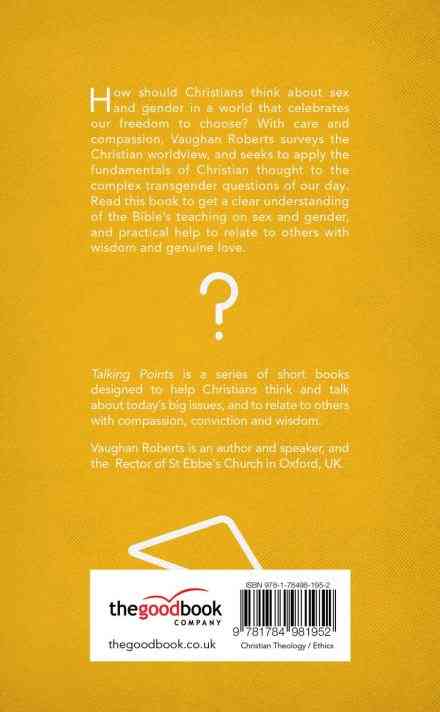
Transgender by Vaughan Roberts is a short, clear, and pastorally wise guide to exactly these questions. Part of the Talking Points series — a collection of brief, accessible books designed to help Christians engage today's most pressing cultural issues with compassion, conviction, and wisdom — this book offers a starting point for thinking and conversation that is both biblically grounded and genuinely helpful for navigating a complex and rapidly changing landscape.
One of the most important things to understand about this book is what it is not. It is not a polemical attack on transgender people or the transgender movement. It is not a political manifesto. It is not a book written in anger or fear.
It is a book written by a pastor who cares deeply about people — including people who are experiencing genuine suffering around their gender identity — and who believes that the Christian worldview, rightly understood and compassionately applied, offers something genuinely good and genuinely true in the midst of cultural confusion.
Vaughan Roberts approaches the subject with the care and generosity that it demands: acknowledging the complexity and the pain, taking the questions seriously, engaging honestly with the cultural shifts that have brought these questions to the foreground, and then applying the principles of a Christian worldview to the many specific questions that arise.
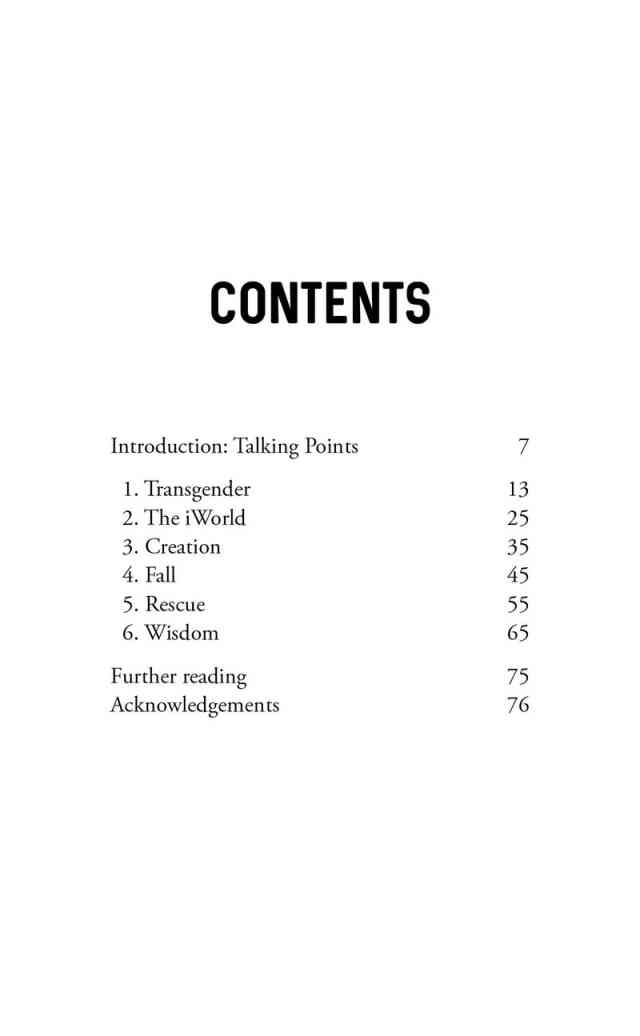
Roberts begins by surveying the cultural landscape — tracing how and why questions of gender identity have moved so rapidly from the margins to the centre of public life. He then sets out the key elements of a Christian worldview as it relates to gender: creation and the goodness of embodied, gendered human life; the fall and the reality that suffering, confusion, and distress in every area of human experience — including gender — are real consequences of a broken world; and redemption and the hope of new creation that the gospel offers to every person, whatever their experience.
From this framework, he addresses the specific questions that Christians and churches are navigating: What is gender dysphoria, and how should we understand it? How do we relate to someone who identifies as transgender? What language should we use? How should churches respond? What does pastoral care for transgender people look like? How do we engage the broader cultural conversation with both faithfulness and grace?
These are questions that resist simple answers — and Roberts does not pretend otherwise. But he provides a genuinely helpful starting point and a model of the kind of thoughtful, compassionate engagement the subject requires.
The subtitle of the Talking Points series captures the spirit of this book exactly: compassion, conviction, and wisdom. Roberts refuses to choose between these — and in doing so, he models the approach the church desperately needs in this cultural moment.
Compassion without conviction produces a Christianity that has nothing distinctive to say — that simply agrees with whatever the culture concludes. Conviction without compassion produces a Christianity that is right about the truth but disastrous in its pastoral application — damaging people in the name of faithfulness. Wisdom holds the two together, asking not just what is true but how truth is communicated, in what relationships, with what tone, and toward what end.
Transgender is an exercise in exactly this kind of wisdom — and it is all the more valuable for its brevity. It is the kind of book that can be read in an evening, discussed in a small group or staff meeting, and returned to repeatedly as specific pastoral situations arise.
Vaughan Roberts is the Rector of St Ebbe's Church in Oxford, England, and a widely respected pastor, author, and speaker in the evangelical Anglican tradition. He is the author of several widely-read books including God's Big Picture — a biblical theology of the whole Bible — and the entire Talking Points series, which addresses pressing cultural issues including same-sex attraction, transgenderism, and mental health with the combination of biblical faithfulness and pastoral warmth that has characterised his ministry across decades. He is known for speaking and writing with particular honesty and personal vulnerability — including about his own experience of same-sex attraction — and this gives his engagement with questions of sexuality and gender an authority and pastoral credibility that purely academic treatments rarely achieve. His work is published by The Good Book Company and is used by churches and individuals worldwide.
Transgender is part of the Talking Points series from The Good Book Company — a collection of short books by Vaughan Roberts designed to help Christians think, talk, and relate to others with compassion, conviction, and wisdom about today's most pressing cultural and ethical issues. Other titles in the series address subjects including same-sex attraction, mental health, and more. Each volume is short enough to read in a single sitting and accessible enough for any Christian to engage with — while being substantive enough to serve as a genuine starting point for thoughtful personal reflection, pastoral conversation, and church discussion.