📖
Opening Shelf & Fetching Catalog...
Connecting to For The Truth theological registry...
Connecting to For The Truth theological registry...
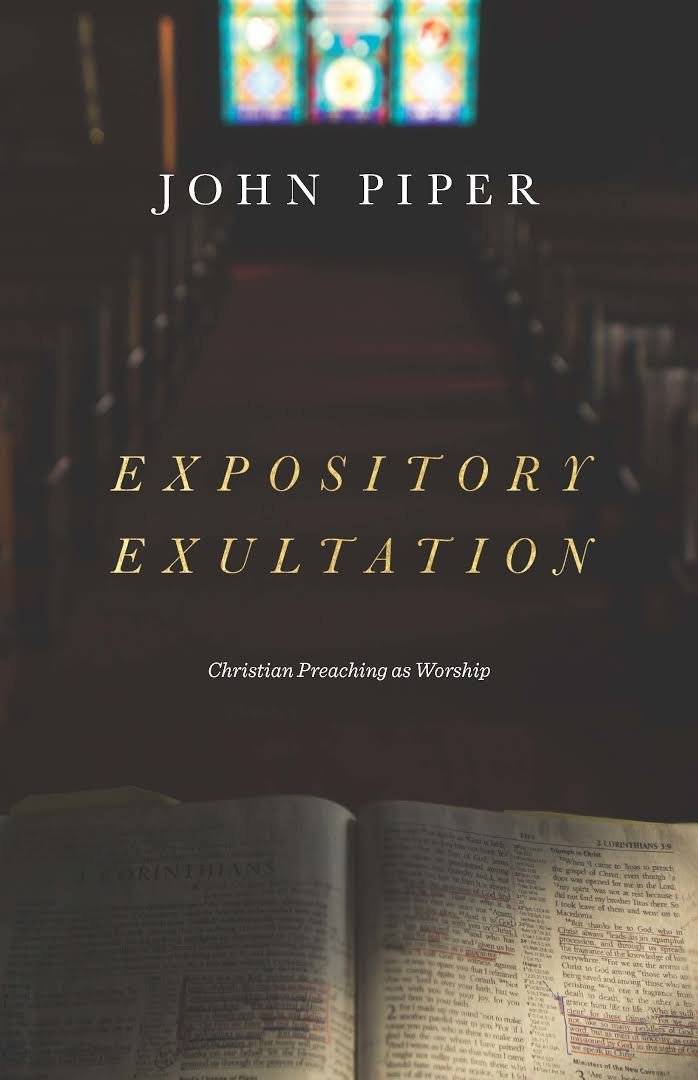
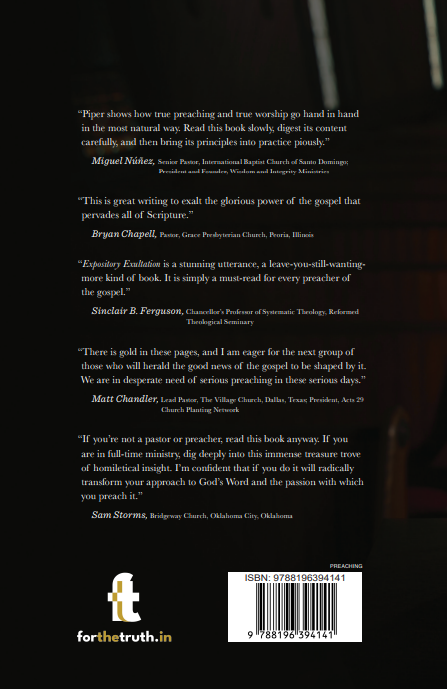
John Piper distills 40 years of preaching into a compelling vision of expository exultation. Essential for every preacher who wants to advance God’s glory.
What is preaching for?
It is a question every preacher eventually asks — and the answer they land on shapes everything about how they approach the pulpit. If preaching is primarily for instruction, the preacher becomes a teacher. If it is primarily for persuasion, the preacher becomes a rhetorician. If it is primarily for encouragement, the preacher becomes a motivational speaker. If it is primarily for information transfer — getting the meaning of the text from the preacher's mind to the congregation's — the preacher becomes an explainer.
All of these things have their place. But John Piper argues, with the conviction and the biblical depth of a man who has spent more than forty years thinking about nothing more carefully, that they all fall short of what preaching is truly appointed by God to accomplish.
Preaching, at its deepest and most biblical level, is not merely an explanation of the text. It is not even primarily instruction or persuasion or encouragement, valuable as those things are. It is something at once simpler and more magnificent than any of them:
It is worship. And it is an awakening of worship.
Expository Exultation is John Piper's most comprehensive and most mature statement of his vision for preaching — distilling over forty years of experience in the pulpit and in the training of preachers into a compelling, biblically grounded, and genuinely transforming account of what Christian preaching is, what it is for, and how it must be done if it is to accomplish the purpose for which God appointed it.
The central claim of Expository Exultation is both simple and radical:
Christian preaching is a God-appointed miracle.
Not a skill to be developed, though skills matter. Not a gift to be exercised, though gifts are real. Not a technique to be mastered, though techniques have their place. A miracle — a supernatural act in which God uses the words of a fallible, finite human being to accomplish something that no amount of natural ability or rhetorical skill could ever produce: the awakening in the hearts of hearers of a genuine, Spirit-given, saving and sanctifying sight of the glory of Jesus Christ.
This is Piper's foundational conviction about preaching — the one that gives his vision its distinctive character and its distinctive urgency. Preaching is not merely a human communication event. It is a divinely appointed means by which God accomplishes his ultimate goal in the world: the gathering and the perfecting of a people who see the glory of Christ, savour the glory of Christ, and show the glory of Christ to a watching world.
When that is what preaching is for — when the preacher understands themselves as a servant of a divine miracle rather than a performer of a human skill — everything about how they prepare, how they pray, how they stand in the pulpit, and what they aim at is transformed.
The first dimension of Piper's vision for preaching is captured in the word expository.
Expository preaching is preaching that is shaped and controlled by the text of Scripture — preaching in which the main point of the sermon is the main point of the passage, in which the structure of the sermon reflects the structure of the text, and in which the applications arise naturally from what the biblical author was inspired by the Holy Spirit to say.
Piper makes a compelling biblical case for this kind of preaching — not as a stylistic preference or a homiletical tradition, but as the necessary implication of what the Bible actually claims to be. If Scripture is the living and active word of God, sharp enough to penetrate to the deepest levels of the human heart, then the preacher's primary task is not to use the text as a springboard for their own thoughts but to let the text speak — to open it up faithfully, clearly, and compellingly so that the congregation encounters not the preacher's ideas but God's own word.
This means that expository preaching is fundamentally a posture of submission. The preacher stands under the text, not over it. They are not the authority — they are the servant of the authority. And the discipline of genuine expository preaching is the discipline of consistently subordinating personal preferences, cultural assumptions, and favourite themes to the specific, particular, authorially intended meaning of the passage being preached.
Piper shows how this discipline — demanding as it is — is also the source of the preacher's greatest freedom and greatest power. Because the word of God, faithfully opened and clearly proclaimed, carries a power that no amount of rhetorical brilliance or personal charisma can manufacture. It is the seed that produces fruit that lasts.
The second dimension of Piper's vision is captured in the word exultation — and it is here that his account of preaching becomes most distinctive and most personally searching.
Exultation is not merely the communication of information about God's glory. It is the active, visible, personally inhabited experience of that glory by the preacher — overflowing into the sermon as an act of worship in itself.
Piper's argument is that the preacher who has genuinely seen the glory of Christ in the text — who has spent time in the word not merely gathering information for a sermon but encountering the living God — will preach differently from the preacher who has merely done their exegetical homework. The difference is not primarily one of technique or style. It is the difference between a person describing the sun and a person who has just walked out of a dark building into brilliant sunlight. One is conveying information. The other is conveying an experience — and the experience, when it is genuine, is contagious.
This is what Piper means by preaching as worship. Not that the sermon replaces the congregational singing or the prayer or the sacraments. But that the sermon, at its best, is itself an act of worship — the preacher's own seeing and savouring of the glory of Christ overflowing into words that awaken the same seeing and savouring in those who hear.
This vision transforms the preacher's preparation as much as it transforms their delivery. Because a preacher who understands preaching as worship will not be satisfied with merely understanding the text — they will not leave their study until they have been moved by it. They will not stand in the pulpit to deliver information they have gathered — they will stand to share something they have encountered.
Running through Expository Exultation is Piper's account of the three supernatural aims of Christian preaching — the three things that God intends the miracle of preaching to accomplish in those who hear:
Seeing the glory of Christ The first aim of preaching is to awaken in the hearers a genuine, Spirit-given sight of the glory of Jesus Christ as he is revealed in the text of Scripture. Not merely an intellectual understanding of the facts about Christ — but a genuine, personally transforming apprehension of his beauty, his worth, and his absolute supremacy over everything else that competes for the allegiance and the affection of the human heart.
Piper shows how this supernatural seeing is not something the preacher can produce — it is the work of the Holy Spirit, who alone can open the eyes of the spiritually blind to see what is genuinely there in the text. But the preacher is the instrument through which the Spirit works — and the quality, the faithfulness, and the exultant character of the preaching are not irrelevant to whether that seeing is awakened.
Savouring the glory of Christ Seeing must lead to savouring — to the deep, personal, joy-producing delight in the glory of Christ that is the hallmark of genuine faith. Piper's central conviction — that God is most glorified in his people when they are most satisfied in him — runs through every page of this book. The preacher who aims only to inform does not aim high enough. The aim is not merely that the congregation should know more about Christ — it is that they should love him more, delight in him more, find him more satisfying and more precious than anything else the world offers.
Showing the glory of Christ What is seen and savoured must be shown — in the life of the preacher, in the life of the congregation, and through the congregation's witness to the world around it. Preaching that produces genuine seeing and genuine savouring inevitably produces people whose lives are visibly shaped by what they have seen — whose relationships, whose priorities, whose generosity, whose courage, and whose joy all declare something of the glory of the Christ they have encountered.
What makes Expository Exultation uniquely valuable is the depth of experience from which it is drawn.
This is not the book of a young theologian constructing a theory of preaching from first principles. It is the book of a man who has stood in the pulpit for more than forty years — who has preached through virtually every book of the Bible, who has faced the specific, weekly, grinding challenge of producing faithful sermons week after week through every season of personal life and congregational history — and who has found, in those forty years of experience, that the vision of preaching he articulates here is not merely theoretically compelling but practically sustaining.
Piper brings that experience to bear with characteristic honesty. He addresses the failures and the discouragements of preaching ministry as well as its glories. He shows how the vision of preaching as expository exultation sustains the preacher through the long haul of weekly ministry — not by making every sermon a triumph but by keeping the preacher's eyes fixed on the purpose that gives every sermon its significance, regardless of how it was received.
Expository Exultation is essential reading for:
John Piper is the founder of desiringGod.org, chancellor of Bethlehem College and Seminary, and one of the most widely read and deeply influential Christian authors of the past half century. He served as pastor of Bethlehem Baptist Church for 33 years — during which time he delivered thousands of sermons and shaped the preaching of generations of pastors who sat under his ministry or encountered his teaching.
Expository Exultation represents the mature fruit of that lifetime of preaching and reflection — his most comprehensive statement of what preaching is, what it is for, and how it must be done if it is to accomplish the miracle God has appointed it to accomplish.
Other John Piper titles available at forthetruth.in include:
God has appointed preaching. Not as one option among many for communicating religious information. Not as a cultural tradition that can be updated or replaced as communication styles evolve. As the great means — the divinely ordained, supernaturally powered, miracle-dependent means — by which he accomplishes his ultimate goal in the world.
That is an extraordinary claim. And Expository Exultation makes it with the full weight of biblical evidence, forty years of pastoral experience, and the kind of passionate, Christ-exalting, personally inhabited conviction that is itself a demonstration of the vision it describes.
Every preacher who reads this book will be challenged. Every preacher who genuinely receives it will be changed. And every congregation whose preacher has been changed by it will encounter, Sunday after Sunday, a sermon that is more than information — a supernatural act of exultant, expository, God-glorifying, Christ-exalting worship.