₹299.00Original price was: ₹299.00.₹149.00Current price is: ₹149.00.
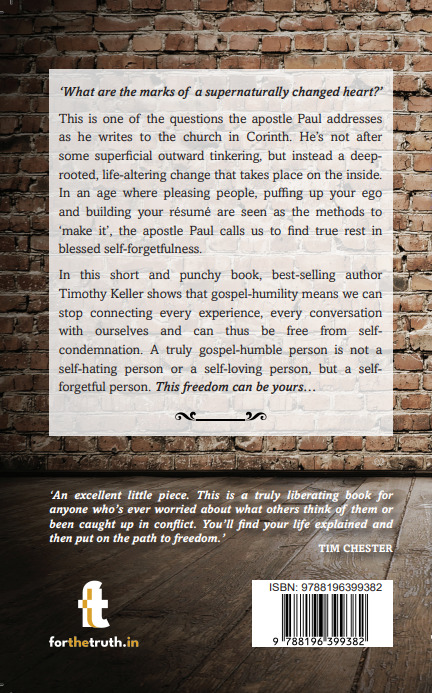
Timothy Keller shows how gospel humility leads to true self-forgetfulness & freedom from self-condemnation. A short, life-changing booklet. Read in one sitting.
The Freedom of Self-Forgetfulness — The Path to True Christian Joy
We live in an age of the self.
Never before in human history has so much attention, so much energy, and so much cultural investment been devoted to the project of managing, improving, promoting, and protecting the self. Social media has made personal branding a daily activity for millions of ordinary people. The self-help industry generates billions of pounds annually on the promise of helping people feel better about who they are. The whole apparatus of contemporary culture is oriented around one central preoccupation: me. My image. My reputation. My feelings. My success. My significance.
And yet — despite all of that attention and all of that investment — genuine, settled, unshakeable peace of mind remains as elusive as ever. Because the self that is constantly being managed, compared, promoted, and protected is also constantly being threatened. Every criticism stings. Every failure haunts. Every comparison leaves you somewhere on a scale of better or worse — and wherever you land, the anxiety is the same. Either you are not as good as you thought you were, or you are not as good as you need to be, or you are not as good as them.
The ego is exhausting. And Timothy Keller has found, in a remarkable passage from the apostle Paul’s first letter to the Corinthians, the most liberating alternative to this exhaustion that anyone has ever described.
The Freedom of Self-Forgetfulness is a short, punchy, and genuinely extraordinary booklet that shows every reader what gospel humility actually looks like — and why the path to true Christian joy runs not through better self-management or higher self-esteem, but through the blessed, gospel-produced freedom of self-forgetfulness.
The Question Paul Was Answering
The booklet begins with a question — one of the questions that the apostle Paul addresses as he writes to the church in Corinth:
What are the marks of a supernaturally changed heart?
This is not a peripheral question. It is the question that gets to the very centre of what the gospel does in a human life — not the superficial outward tinkering that passes for spiritual improvement in much contemporary Christianity, but the deep-rooted, life-altering, inside-out transformation that genuine encounter with the grace of God actually produces.
Paul’s answer in 1 Corinthians 3 and 4 is one of the most psychologically insightful and most personally liberating passages in the entire New Testament. It is also one of the least well-known and least well-understood. And Keller opens it up with the kind of clarity, the kind of cultural intelligence, and the kind of genuine pastoral warmth that made his ministry so widely trusted and so deeply transformative for so many people.
The Ego — The Problem That Won’t Stay Solved
Before Keller can show us what self-forgetfulness is, he needs to show us what we are dealing with — the nature of the ego and the specific ways in which it makes the human experience of self-awareness so exhausting and so painful.
The ego, as Keller describes it, is the self that is constantly being evaluated. Not primarily by others — though that happens too — but by ourselves. We carry around an internal court, constantly in session, constantly reviewing the evidence, constantly returning verdicts about how we are doing, how we are coming across, how we measure up against the standard we have set for ourselves or that others have set for us.
Some days the verdict is favourable. We feel good about ourselves — our performance, our appearance, our relationships, our spiritual life. And on those days, we are vulnerable to pride — the quiet, self-satisfied pleasure of a positive verdict that makes us subtly less compassionate toward others and subtly less dependent on God.
Other days the verdict is damning. The self-condemnation that Paul describes — the internal court that finds us guilty, that reminds us of every failure and every inadequacy and every way in which we have fallen short — makes those days genuinely painful. And the instinct on those days is either to fight back against the verdict by working harder to justify ourselves, or to accept it and sink into the shame and the discouragement that a negative verdict produces.
Either way, the ego is in charge. Either way, we are exhausted. And either way, we are missing the extraordinary freedom that Paul describes — the freedom that only the gospel can produce.
What Gospel Humility Actually Is
This is where The Freedom of Self-Forgetfulness becomes genuinely and profoundly liberating — because Keller’s description of gospel humility is not what most people expect it to be.
Most people think of humility as thinking badly of yourself. Downplaying your gifts. Deflecting compliments. Saying the right self-deprecating things at the right moments to avoid giving the impression that you think too highly of yourself. This version of humility is exhausting in a different way from pride — but it is still the ego at work, still the self constantly under evaluation, still the same internal court trying to return the right verdict.
Gospel humility, as Paul describes it and as Keller opens it up, is something completely different. It is not thinking badly of yourself. It is not thinking about yourself at all.
The truly gospel-humble person is not a self-hating person. They are not a self-loving person. They are a self-forgetful person. Someone who has been so captured by the grace of God, so genuinely absorbed in knowing and being known by the one who loves them completely — that the self simply stops being the centre of their attention. Not because they have successfully suppressed their ego through spiritual discipline, but because they have found something so much more interesting and so much more satisfying to be occupied with.
This is what a supernaturally changed heart looks like. Not a heart that has learned to manage its ego better — but a heart that has been freed from the tyranny of the ego altogether by an encounter with a grace that is bigger, deeper, and more personally significant than anything the ego can offer.
The Three Dimensions of Self-Forgetfulness
Drawing carefully and insightfully from 1 Corinthians 3 and 4, Keller opens up three specific dimensions of the self-forgetfulness that Paul describes — three ways in which gospel humility frees a person from the exhausting self-preoccupation that characterises the ego:
Freedom from other people’s opinions Paul says he cares very little if he is judged by the Corinthians or by any human court. This is not arrogance — it is freedom. The freedom of the person who no longer needs the approval of others to feel secure, because their security comes from somewhere that human opinion can neither give nor take away. Keller shows how this freedom — which sounds almost impossibly countercultural — is the direct, practical consequence of knowing that your identity is established by the verdict of God in the gospel rather than by the verdicts of the people around you.
Freedom from self-condemnation Paul also says that his conscience is clear — but he adds, crucially, that this does not make him innocent. He is not claiming to be perfect. He is claiming to be free from the self-condemnation that imperfection would otherwise produce — because the court that matters has already returned its verdict, and that verdict was rendered not on the basis of his performance but on the basis of the righteousness of Christ credited to him by grace through faith. Keller shows how this freedom from self-condemnation is not the freedom of the person who has nothing to feel condemned about, but the freedom of the person who knows that their condemnation has already been borne by another.
Freedom to stop connecting everything to yourself Perhaps the most practically significant dimension of self-forgetfulness is the freedom it creates to be genuinely present to other people and to the world around you — to have conversations that are not secretly about you, to hear other people’s stories without constantly relating them back to your own experience, to enjoy things for what they are without asking what they say about you. Keller shows how this quality — the capacity to be genuinely other-focused rather than perpetually self-referential — is one of the most attractive and most relationally transforming fruits of gospel humility.
What This Booklet Will Help You Do
Understand clearly what gospel humility actually is — and why it is so different from both self-hatred and self-improvement
Engage with Paul’s extraordinary passage in 1 Corinthians 3 and 4 and see in it a vision of the self-forgetful life that is both theologically serious and genuinely personally liberating
Find genuine freedom from other people’s opinions — not through indifference or arrogance but through the settled security of knowing that your identity is established by the gospel
Experience freedom from self-condemnation — not because your failures are not real but because the verdict that matters has already been rendered in Christ
Develop the capacity to stop connecting every experience and every conversation to yourself — and discover the joy and the relational richness that genuine other-focus makes possible
Understand why self-forgetfulness is the path to true Christian joy — not a discipline to be achieved but a freedom to be received as the natural fruit of genuine gospel encounter
Share this booklet with anyone who is exhausted by the ego — by the constant self-management, self-promotion, and self-condemnation that characterises life without the freedom of the gospel
Who Should Read This Book?
The Freedom of Self-Forgetfulness is essential reading for:
Every Christian who is exhausted by the constant work of managing, protecting, and evaluating the self — and who needs the liberating alternative that the gospel provides
Believers who struggle with self-condemnation — who have received God’s forgiveness in principle but who cannot seem to stop condemning themselves in practice
Christians who are over-sensitive to criticism — whose sense of wellbeing rises and falls with the opinions of others — and who need the freedom that comes from having their identity established somewhere more secure
Pastors and church leaders who want a reliable, accessible, and genuinely transforming resource on gospel humility to recommend to congregation members or use in a teaching context
Small groups wanting a short, discussion-rich, personally searching study that can be read and discussed in a single gathering
Young adults and students navigating the particular pressures of self-promotion and comparison that social media culture generates — and needing a genuinely compelling alternative framework
Anyone who has ever felt that they spend too much energy thinking about themselves — and who wants to discover the extraordinary freedom of a life that has been freed from that preoccupation by the grace of the gospel
Christians in India navigating the specific pressures of reputation, comparison, and social expectation in Indian culture — and needing the gospel’s liberating alternative to the exhausting work of managing others’ perceptions
About the Author
Timothy Keller was the founding pastor of Redeemer Presbyterian Church in New York City — one of the most influential churches in the English-speaking world — and the author of numerous bestselling books including The Reason for God, The Prodigal God, Prayer, and The Meaning of Marriage. He was widely regarded as one of the most gifted Christian communicators and apologists of his generation — known above all for his ability to make the deep truths of Reformed theology genuinely accessible and personally transforming for sceptics and believers alike.
The Freedom of Self-Forgetfulness is one of his most beloved and most widely shared works — short enough to read in one sitting, and profound enough to stay with a reader for a lifetime.
Other Timothy Keller titles available at forthetruth.in include:
Romans 8-16: In View of God’s Mercy
Judges For You
The Freedom That Is Already Yours
The ego is never satisfied. It is always comparing, always evaluating, always either swelling with pride or sinking with shame — and always, underneath it all, exhausted by the effort of keeping the whole performance going.
The freedom that the gospel offers is not the freedom of a better-managed ego. It is the freedom of an ego that has been displaced — quietly, gracefully, supernaturally — by something so much bigger and so much more satisfying that the self simply stops demanding all the attention it once commanded.
That freedom is already yours in Christ. The verdict has been rendered. The identity has been established. The court has adjourned. And the person who truly knows this — who has received it not just as a theological proposition but as a living, daily, personally inhabited reality — is a person who is free. Free from other people’s verdicts. Free from their own self-condemnation. Free to forget themselves entirely and to be genuinely, joyfully, fully present to God and to the people around them.
The Freedom of Self-Forgetfulness is an invitation to that freedom. It can be read in one sitting. It has the potential to change everything.
Weight :
0.045 kg
Dimensions :
17.53 × 10.92 × 0.51 cm
Age range :
14-99
Format :
Paperback
ISBN :
9788196399382
Language :
English
Pages :
48
Publisher :
FOR THE TRUTH
HSN :
4901
6 reviews for The Freedom of Self-Forgetfulness – Booklet - Paperback
Rated 5 out of 5
David Zahid –
Rated 5 out of 5
David Zahid –
Rated 5 out of 5
Anonymous –
Rated 5 out of 5
Anonymous –
Rated 5 out of 5
Sabeela Alexander –
Rated 5 out of 5
Michael Menezes –
Only logged in customers who have purchased this product may leave a review.








David Zahid –
David Zahid –
Anonymous –
Anonymous –
Sabeela Alexander –
Michael Menezes –