


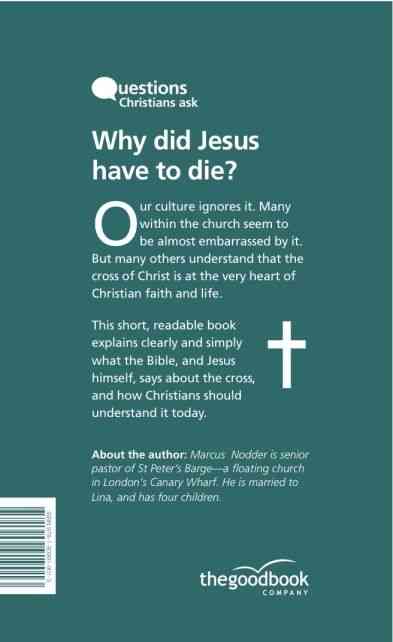


Why did Jesus have to die? - and other questions about the cross of Christ and its meaning for us today - Paperback
Marcus NodderOriginal price was: ₹599.00.₹249.00Current price is: ₹249.00.
Why Did Jesus Have to Die? by Marcus Nodder is a clear and biblical explanation of the heart of the Christian gospel. It explores why Jesus’ death was necessary, what it accomplished, and how the cross reveals God’s justice, love, forgiveness, and salvation. A helpful resource for anyone wanting to better understand and explain the meaning of the cross.
Part of the Questions Christians Ask Series
Only 4 left in stock
The Cross Is Either Everything — or It Is Nothing.
Culture has made it a fashion accessory. Liberal Christianity has made it an embarrassing relic of primitive theology. And even within evangelical churches, the specific question of why Jesus had to die — not just that he did, but what exactly his death accomplished and why it had to happen that way — is often assumed rather than explained, celebrated without being understood.
Why Did Jesus Have to Die? by Marcus Nodder is a short, clear, and biblically honest answer to one of the most important questions anyone can ask about the Christian faith. Part of the Questions Christians Ask series from The Good Book Company, it takes the reader directly to what the Bible — and Jesus himself — actually says about the cross, and helps Christians understand, articulate, and be gripped by the heart of the gospel.
The Question Culture Would Rather Avoid
There is something deeply uncomfortable about the cross for modern sensibilities. The idea that God required the death of his Son — that forgiveness could not simply be granted without cost, that justice demanded a reckoning, that salvation required blood — strikes many people as primitive, violent, and morally troubling. Why couldn’t God just forgive?
Nodder addresses this question with the seriousness it deserves. He does not dismiss the difficulty or pretend that the cross is self-evidently intelligible to everyone who encounters it. But he does show — carefully, biblically, and compellingly — that the cross is not the embarrassing centrepiece of an outdated theology but the most profound and most necessary act in the history of the universe. Far from being primitive or morally troubling, it is the fullest expression of both God’s justice and God’s love — the place where they meet, in the person of the Son, in the most costly and most glorious way imaginable.
What the Bible — and Jesus Himself — Says
One of the most important features of this book is its consistent return to the primary sources. Nodder does not explain the cross primarily through the lens of later theological formulations, church tradition, or contemporary debate. He goes to what the Bible actually says — and particularly to what Jesus himself said about his own death.
This matters because Jesus was not a passive victim of circumstances. He went to the cross deliberately, knowingly, and with a clear theological understanding of what he was doing. He spoke about his death as a ransom, as a sacrifice, as the fulfilment of Scripture, as the giving of himself for others. Understanding the cross means understanding it the way Jesus understood it — and Nodder helps readers do exactly that, with clarity and genuine biblical care.
Penal Substitution — and More
The book engages with the different biblical metaphors and models through which the New Testament explains the atonement — and shows how they work together to give a full and biblically faithful picture of what Jesus accomplished on the cross.
The language of sacrifice — the offering that deals with sin and makes the worshipper acceptable before God. The language of redemption — the ransom that buys freedom for those who are enslaved. The language of justification — the verdict that declares the guilty righteous because another has borne the penalty. The language of reconciliation — the restoration of a broken relationship between God and humanity.
Nodder shows how these different biblical images are not competing theories of the atonement but complementary windows onto a single glorious reality — the death of Jesus as the act in which God dealt with sin, satisfied justice, purchased freedom, and restored relationship, all at once, in the person of his Son.
Why the Cross Must Not Be Minimised
Part of the urgency of this book is its honest engagement with the tendency — both in wider culture and within parts of the church — to minimise or be embarrassed by the cross. Some do so by treating it as merely an inspiring example of self-giving love. Others do so by emphasising the resurrection while quietly marginalising the death. Others do so by finding the language of wrath, penalty, and substitution too offensive for contemporary ears and quietly replacing it with softer alternatives.
Nodder is gentle but clear: the cross cannot be minimised without losing the gospel. A Jesus who died only as an example is not a Jesus who can save. An atonement that does not deal with the real problem of human sin and divine justice is not an atonement that delivers real forgiveness and real hope. The specificity of what Jesus did on the cross — the why of it — is not a peripheral detail but the load-bearing centre of the Christian message.
Why It Matters for Christians Today
The final movement of the book is its application — showing how a clear, biblically grounded understanding of the cross shapes the whole of Christian life. How it generates genuine humility — the recognition that we could not save ourselves. How it generates genuine confidence — the assurance that what Jesus accomplished is complete and sufficient. How it generates genuine love — the response of those who know how much they have been forgiven. How it generates genuine courage — the willingness to suffer for the sake of the one who suffered infinitely for us.
The cross is not just the entry point of the Christian life. It is its continuing heartbeat — the truth that every Christian needs to return to again and again, not just to understand but to be transformed by.
What This Book Covers
- Why the cross is at the very heart of Christian faith and cannot be minimised or avoided
- What culture’s embarrassment with the cross reveals — and why it is misplaced
- What the Bible — and Jesus himself — says about the purpose and meaning of his death
- The key biblical images for the atonement: sacrifice, redemption, justification, reconciliation
- Penal substitution — what it means, why it is biblical, and why it matters
- How the different biblical models of the atonement work together to give a complete picture
- Why minimising the cross loses the gospel — the pastoral and theological urgency of the subject
- How understanding the cross shapes Christian life: humility, confidence, love, and courage
What Readers Will Gain
- A clear, biblically grounded, and practically useful understanding of why Jesus had to die
- Confidence to explain and commend the cross to others — including those who find it difficult or offensive
- A deeper, more personally transforming grasp of what Jesus accomplished on the cross and what it means for them personally
- Freedom from the vague, cross-minimising Christianity that robs believers of the full assurance and joy the gospel provides
- A short, accessible, and genuinely trustworthy resource to give to any Christian struggling to understand or articulate the cross
- The kind of renewed wonder at the cross that reshapes worship, prayer, and daily Christian living
Who Should Read This Book
- Christians who have always assumed the cross is central but have never clearly understood why Jesus had to die
- New believers wanting a clear, accessible explanation of the heart of the gospel
- Christians who have encountered challenges to the cross — from culture, from sceptical friends, or from within the church — and want a biblically grounded response
- Pastors and church leaders wanting a reliable, short resource to give to church members with questions about the atonement
- Churches in India where the cross is proclaimed but where clear, accessible teaching on why Jesus had to die is often needed — particularly in contexts where other religious frameworks offer different accounts of sin, forgiveness, and salvation
- Christians wanting to be able to explain the cross to unbelieving friends or family members
- Small groups wanting a short, biblically grounded resource on the central event of the Christian faith
- Anyone who has ever been challenged by the question: Why couldn’t God just forgive without the cross?
About the Author
Marcus Nodder is a pastor and author based in the UK, and a contributor to The Good Book Company’s Questions Christians Ask series. He is also the author of What Happens When I Die? — another volume in the same series. His writing is known for bringing genuine theological clarity to subjects that are often handled either too vaguely or too speculatively — making complex biblical truths genuinely accessible for ordinary Christians without sacrificing accuracy or depth. His contribution to Why Did Jesus Have to Die? reflects a pastor’s conviction that the cross must never be assumed or minimised, and a biblical teacher’s commitment to opening up its meaning from Scripture itself.
About the Questions Christians Ask Series
Why Did Jesus Have to Die? is part of the Questions Christians Ask series from The Good Book Company — a range of short, readable books which clearly explain how the Bible answers the questions Christians are asking. Other titles in the series include:
- What Happens When I Die? by Marcus Nodder
- Did the Devil Make Me Do It? by Mike McKinley
- How Can I Be Sure? by John Stevens
- Why Bother With Church? by Sam Allberry
- Can I Really Trust the Bible? by Barry Cooper
- and more
- Weight : 0.087 kg
- Dimensions : 17.53 × 10.67 × 1.02 cm
- Format : Paperback
- ISBN : 9781909919020
- Language : English
- Pages : 96
- Publisher : THE GOOD BOOK COMPANY
- HSN : 4901
6 reviews for Why did Jesus have to die? - and other questions about the cross of Christ and its meaning for us today - Paperback
Only logged in customers who have purchased this product may leave a review.
Related products
-
God’s Big Promises Bible Storybook - Hardback
Original price was: ₹2,499.00.₹699.00Current price is: ₹699.00. -

Inspector Smart and the Case of the Empty Tomb - Paperback
Original price was: ₹699.00.₹349.00Current price is: ₹349.00. -
A Very Happy Easter - Paperback
Original price was: ₹699.00.₹249.00Current price is: ₹249.00. -

God and the Transgender Debate (Second Edition) - What Does the Bible Actually Say about Gender Identity? - Paperback
Original price was: ₹799.00.₹349.00Current price is: ₹349.00.

David Zahid –
David Zahid –
john –
Very good book
Anonymous –
Joshua John Pazhayampallil –
Sabeela Alexander –