
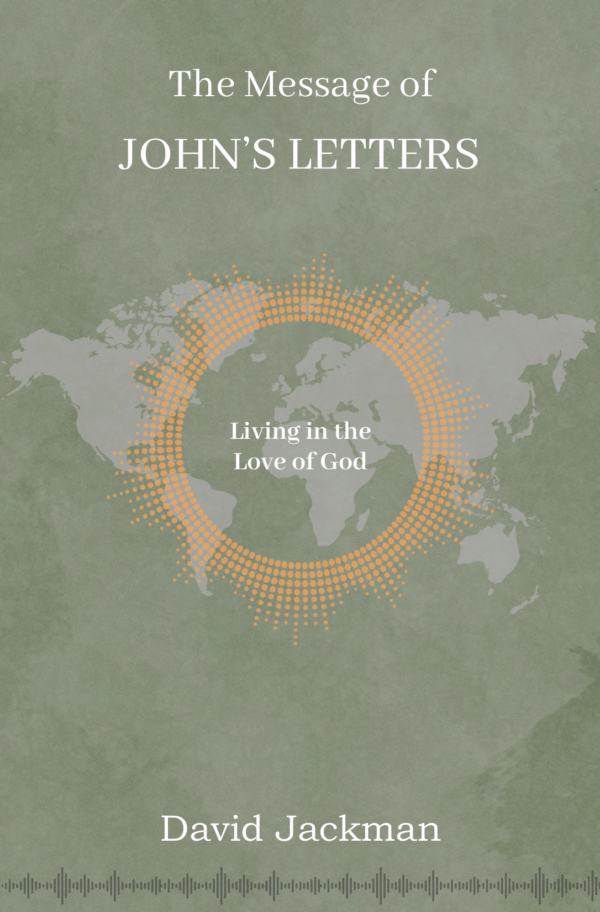
The Message of John’s Letters - Paperback
David JackmanOriginal price was: ₹1,399.00.₹649.00Current price is: ₹649.00.
Please Contact us if you want to get the whole set!
David Jackman opens 1, 2 & 3 John with clarity on truth & love. A revised Bible Speaks Today commentary with study guide. Perfect for study & preaching.
Part of the Bible Speaks Today Commentaries Series
In stock
The Message of John’s Letters — Truth and Love for the Church in Every Age
The problems John was writing to address sound disturbingly familiar.
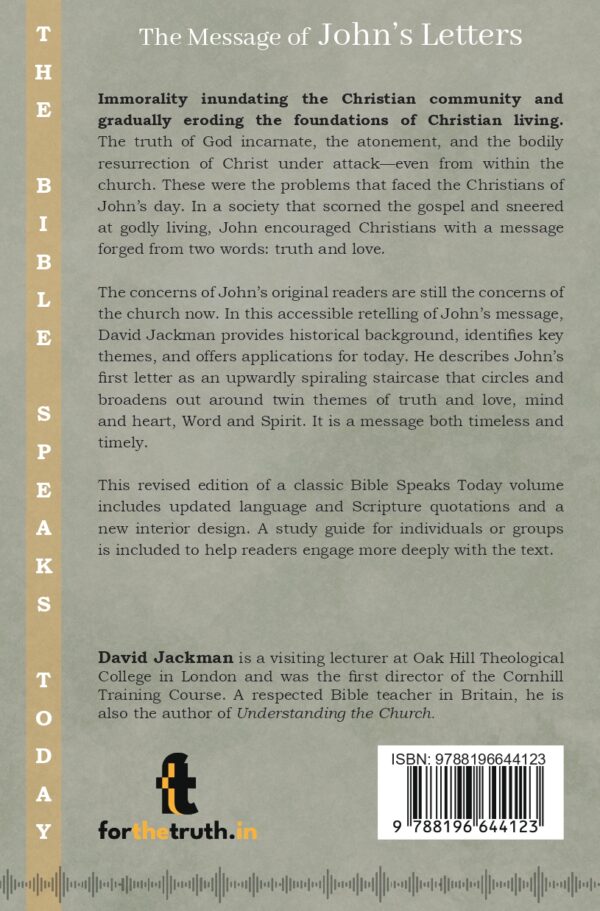
Immorality quietly inundating the Christian community and gradually eroding the foundations of Christian living. The foundational truths of the gospel — the incarnation of God, the atoning death of Christ, the bodily resurrection — being questioned, reinterpreted, and denied, not from outside the church but from within it. A surrounding society that scorned the gospel and sneered at godly living, creating relentless pressure on believers to accommodate, to compromise, and to soften the hard edges of a faith that the world found increasingly uncomfortable.
These were the pressures facing the Christians of John’s day. And they are — with remarkable and sometimes unsettling precision — the pressures facing the church today.
Into that situation, the apostle John wrote with the concentrated clarity of a man who had walked with Jesus, who had seen the resurrection, who had spent a lifetime thinking about what the gospel demanded of those who claimed to believe it. And the message he forged was built on two words:
Truth. And love.
The Message of John’s Letters by David Jackman is a revised edition of a classic volume in the Bible Speaks Today series — an accessible, carefully grounded, and genuinely enriching guide through 1, 2, and 3 John that opens up these two great themes with the clarity and the pastoral warmth that John’s own letters model so compellingly.
The Upward Spiral — A Unique Approach to 1 John
One of the most illuminating features of Jackman’s commentary is the image he uses to describe the structure of John’s first letter: an upwardly spiraling staircase.
1 John does not move in a simple linear progression from point A to point B. It circles — returning again and again to the same great themes, approaching them from slightly different angles, adding new dimensions to what has already been said, broadening and deepening the reader’s understanding with each return. The themes of truth and love, of mind and heart, of Word and Spirit — these are not addressed once and then left behind. They are woven through the whole letter in a way that is cumulative and mutually illuminating, each pass around the spiral adding to what has gone before.
This image — the upwardly spiraling staircase — is not just a descriptive convenience. It is a genuinely helpful key to reading and understanding 1 John. Readers who grasp it will find the letter’s structure coherent and its message increasingly clear. Readers who approach it expecting a simple linear argument will repeatedly find themselves confused by the apparent repetitions and circlings-back that are actually among the letter’s greatest strengths.
Jackman’s commentary guides readers through the spiral with patience, clarity, and the kind of passage-by-passage attention that helps every reader stay oriented and keep sight of the overarching message even when the letter’s movement feels complex.
Truth — The Foundation That Must Not Be Abandoned
The first of John’s two great themes — truth — was under assault in his day in ways that have their direct parallels in the contemporary church.
The specific false teaching that John was addressing appears to have been an early form of what would later develop into Gnosticism — a movement that denied the genuine humanity of Christ, that treated the physical world as inherently inferior to the spiritual, and that claimed a special spiritual knowledge that placed its adherents beyond the ordinary moral obligations of the gospel. The result was a community that could affirm spiritual realities while dismissing the moral demands of Christian living — that could claim to know God while living in ways that contradicted everything genuine knowledge of God produces.
John’s response is uncompromising. The truth of the incarnation — that the eternal Word genuinely became flesh, that the Son of God genuinely lived and suffered and died and rose in a real human body — is not negotiable. It is not a theological refinement that can be adjusted to accommodate the preferences of a sophisticated intellectual culture. It is the foundation of everything. And a community that loses its grip on that foundation does not merely have an intellectual problem — it has lost the gospel.
Jackman opens up John’s defence of doctrinal truth with the clarity and the pastoral urgency that the subject demands — showing not just what John taught but why it matters, and what the church loses when it allows the pressure of cultural accommodation to erode the truths on which the gospel stands.
Love — The Fruit That Must Not Be Neglected
But truth without love is not the gospel either. And the second of John’s great themes — love — is every bit as central to his message as the first.
The love John describes is not sentiment. It is not the warm feeling that naturally develops between people who share common interests and comfortable circumstances. It is the love that God himself showed in sending his Son — costly, sacrificial, other-oriented, willing to give everything for the good of those it is directed toward. And it is the love that those who have received that divine love are called to extend to one another — as the mark that distinguishes the genuine children of God from those who claim the name without the reality.
Jackman shows how truth and love, in John’s letters, are not competing values but mutually reinforcing ones. The community that holds the truth of the gospel without love is not a healthy community — it is a cold, self-righteous, theologically correct but relationally barren gathering that does not reflect the character of the God it claims to know. And the community that emphasises love without truth is not a loving community — it is a community that has sacrificed the very message that makes genuine, transforming, gospel-shaped love possible.
The integration of truth and love — mind and heart, Word and Spirit — is not just a theological programme for the church. It is the living, daily, personally demanding calling of every Christian who genuinely knows the God of truth and love.
The Problems of John’s Day — And Ours
One of the most valuable features of Jackman’s commentary is its consistent attention to the parallels between the challenges John’s original readers faced and the challenges the contemporary church faces.
The immorality that was inundating the Christian community of John’s day — gradually, quietly, almost imperceptibly eroding the foundations of Christian living — has its direct contemporary parallels in the ways in which the surrounding culture’s sexual ethics, its materialism, and its relativism seep into the church through a thousand small accommodations that individually seem harmless and cumulatively are devastating.
The doctrinal attacks of John’s day — the denial of the incarnation, the reinterpretation of atonement, the questioning of bodily resurrection — have their direct contemporary parallels in the theological revisionism that regularly emerges from within the church and that John’s insistence on the non-negotiability of foundational truths addresses with remarkable precision.
The social pressure of John’s day — the scorning of the gospel and the sneering at godly living by a surrounding culture that found Christian distinctives embarrassing — has its direct contemporary parallel in every cultural context where Christians face the pressure to accommodate, to soften, and to become more palatable to the world around them.
Jackman draws these parallels carefully and helpfully — not forcing contemporary applications on an ancient text, but allowing John’s own concerns to illuminate the church’s contemporary situation in ways that are both exegetically responsible and genuinely practically useful.
A Revised Edition — With Study Guide
This revised edition of The Message of John’s Letters has been updated with fresh language and Scripture quotations and a new interior design — making a classic commentary even more accessible and more visually engaging for contemporary readers.
But the most practically significant addition to this edition is the study guide for individuals or groups included at the back of the book. This guide provides structured questions and discussion prompts that help readers engage more deeply with the text — making the commentary suitable not just for personal study but for small group use, church Bible study groups, and any context where Christians want to work through 1, 2, and 3 John together with the kind of careful, structured engagement that Jackman’s commentary makes possible.
What This Commentary Will Help You Do
- Understand clearly the historical situation John was addressing — the false teaching, the moral compromise, and the social pressure that shaped his letters — and see its contemporary parallels with fresh clarity
- Navigate the upwardly spiraling structure of 1 John with a framework that makes its movement genuinely comprehensible and its cumulative message genuinely accessible
- Engage seriously with John’s twin themes of truth and love — understanding how they relate to one another, how each depends on the other, and what the church loses when either is neglected
- Use the study guide to engage personally and in groups with the text — developing a deeper, more personally applied understanding of John’s message for the church today
- Preach or teach through 1, 2, and 3 John with the confidence of a reliable, exegetically grounded commentary as preparation and reference
- Be personally challenged and encouraged by John’s vision of the Christian community — a community that holds the truth without coldness and loves without sentimentality
Who Should Read This Book?
The Message of John’s Letters is ideal for:
- Pastors and preachers planning a sermon series through 1, 2, or 3 John and wanting a reliable, accessible, and practically useful commentary
- Individual Christians wanting to study John’s letters seriously with a trustworthy guide that is both exegetically grounded and personally applicable
- Small groups wanting a structured commentary and study guide for working through John’s letters together
- Christians concerned about doctrinal compromise and moral accommodation in the contemporary church who want to understand John’s response to the same pressures in his own day
- Theological students studying New Testament, Johannine literature, or early church history
- Christians in India navigating the pressures of cultural accommodation and doctrinal challenge in the contemporary Indian church — and finding in John’s letters a directly relevant word of truth and love
- Anyone wanting the complete Bible Speaks Today New Testament set — contact forthetruth.in via WhatsApp for the whole series
About the Author
David Jackman is a widely respected British Bible teacher and the founder of the Proclamation Trust — an organisation committed to promoting faithful expository preaching across the English-speaking world and beyond. He is known for his ability to open up the Scriptures with clarity, depth, and genuine pastoral warmth — making complex biblical material genuinely accessible without sacrificing the rigour that serious engagement with God’s Word requires. His treatment of John’s letters in this commentary reflects both his exegetical care and his deep concern for the health and the faithfulness of the contemporary church.
About the Bible Speaks Today Series
The Message of John’s Letters is part of the Bible Speaks Today series — published by IVP and widely regarded as one of the most trusted and most accessible series of biblical commentaries available. Each volume combines rigorous exegetical engagement with clear, warm, practically applied exposition that serves preachers, teachers, and ordinary Bible readers alike.
Other Bible Speaks Today New Testament volumes available at forthetruth.in include The Message of Revelation and many more titles covering the full New Testament.
Contact forthetruth.in to enquire about purchasing the complete set.
The Message That Is Both Timeless and Timely
The problems of John’s day are the problems of our day. The pressures have different shapes and different names — but the underlying dynamics are strikingly, sometimes uncomfortably, familiar. Immorality eroding the foundations. Truth under attack from within. A surrounding culture that scorns the gospel and the godly life it produces.
And into those pressures, John’s message speaks with the same clarity and the same urgency that it carried in the first century:
Hold the truth. Practise the love. Know the God who is the source of both.
The Message of John’s Letters is a guide to receiving that message — and to letting it do in the contemporary church and the contemporary Christian life what it was always written to do.
- Weight : 0.225 kg
- Dimensions : 21 × 13.9 × 1.2 cm
- Age range : 14-99
- Format : Paperback
- ISBN : 9788196644123
- Pages : 212
- Language : English
- Publisher : FOR THE TRUTH
- HSN : 4901
1 review for The Message of John’s Letters - Paperback
Only logged in customers who have purchased this product may leave a review.
Related products
-
The Message of 1 Peter - Paperback
Original price was: ₹1,399.00.₹599.00Current price is: ₹599.00. -
The Message of 1 Corinthians - Paperback
Original price was: ₹1,749.00.₹649.00Current price is: ₹649.00. -
The Message of James - Paperback
Original price was: ₹1,499.00.₹599.00Current price is: ₹599.00. -
The Message of Luke - Paperback
Original price was: ₹1,399.00.₹549.00Current price is: ₹549.00.
Lawrence Yanthan –