₹899.00Original price was: ₹899.00.₹599.00Current price is: ₹599.00.
Oxford Professor John Lennox shows science & Christianity are not opposed but complementary. A compelling case for faith in a scientific age. Buy online.
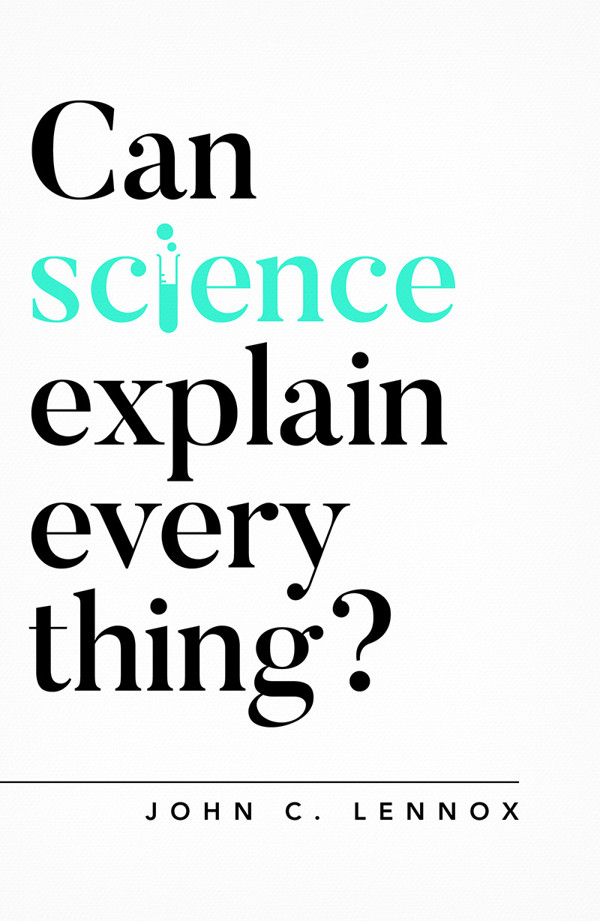
Can Science Explain Everything? — A Fresh Way of Thinking About Science and Christian Faith
Science has achieved extraordinary things.
Clean water for billions. Food for a growing world. Healthcare that has doubled human life expectancy in a century. Technologies that have transformed every aspect of human existence. And the pace of progress shows no sign of slowing — with artificial intelligence, genetic medicine, and the exploration of space promising even more remarkable achievements in the decades ahead.
It is not surprising, then, that many thoughtful people have drawn a straightforward conclusion from all of this: science explains the world. And if science explains the world, then religion — with its ancient texts, its talk of miracles, and its claims about a creator God — is simply redundant. A comforting relic of a prescientific age, now superseded by the cleaner, more reliable explanations that the scientific method provides.
It is a conclusion held by many intelligent, well-informed, genuinely sincere people. And it deserves a serious, carefully reasoned, intellectually honest response.
Can Science Explain Everything? by John Lennox — Professor of Mathematics at Oxford University and one of the world’s most respected Christian apologists — provides exactly that response.
The Man Behind the Book
Before engaging with the argument, it is worth considering the credentials of the person making it.
John Lennox is not a theologian defending religion from the safe distance of a seminary. He is a Professor of Mathematics at the University of Oxford — one of the world’s leading research universities — who has spent his entire career at the highest levels of scientific and academic life. He has engaged publicly with some of the most prominent atheist thinkers of our age, including Richard Dawkins and Christopher Hitchens, and has done so with a combination of intellectual rigour, genuine respect, and quiet confidence that has earned him a hearing far beyond the church.
When John Lennox argues that science and Christianity are not opposed, he is not speaking from ignorance of science or from a defensive desire to protect religious tradition. He is speaking as a working scientist and mathematician who has thought more carefully about these questions than most — and who has found, through that thinking, that Christian faith is not undermined by science but is in fact more intellectually credible in the light of it.
The Common Misconceptions This Book Addresses
At the heart of Can Science Explain Everything? is Lennox’s careful dismantling of the misconceptions — on both sides of the science-religion debate — that prevent the genuine conversation that needs to happen.
Misconception One — Science and Religion are in Conflict The conflict narrative — the idea that science and religion have always been and must always be opposed — is one of the most widely held assumptions in modern Western culture. Lennox shows that it is also one of the most historically inaccurate. The founders of modern science — Galileo, Newton, Faraday, Clerk Maxwell — were not despite being Christians but in many cases precisely because of their Christian convictions about the orderliness and rationality of a created universe. The conflict narrative is a myth — a nineteenth century invention that does not accurately describe either the history of science or the actual relationship between scientific and theological inquiry.
Misconception Two — Science Explains Everything The claim that science can explain everything sounds compelling until you ask what kind of question science is actually equipped to answer. Science is extraordinarily powerful at answering questions about how the natural world works — the mechanisms, the processes, the physical laws that govern observable phenomena. But there is a whole category of questions that science, by its very nature and method, is not designed to answer: questions about meaning, purpose, value, morality, consciousness, and the ultimate origin of the universe itself.
Lennox does not argue that science is limited because it is weak. He argues that it is limited because it is specific — a precise and powerful tool for a particular kind of question, but not the only tool needed for a fully human life or a complete understanding of reality.
Misconception Three — Christianity is Anti-Science The assumption that believing the Bible requires rejecting science is widespread — and Lennox addresses it with both intellectual precision and genuine pastoral care. He shows that the Christian doctrine of creation — the conviction that the universe was made by a rational, personal God — actually provides the philosophical foundation for the scientific enterprise itself. It is because the universe was made by a rational God that it is rationally intelligible. It is because human beings are made in the image of that God that they have the capacity to understand the universe they inhabit.
Far from being enemies, science and Christianity, properly understood, need each other.
The Questions Science Cannot Answer
One of the most important contributions of this book is its clear articulation of the questions that science, by its nature, cannot answer — and the argument that these questions are not therefore meaningless or unanswerable, but that they require a different kind of inquiry.
Science tells us how the universe works. It cannot tell us why there is a universe at all. Science describes the mechanisms of life. It cannot tell us what life means or whether it has ultimate value. Science maps the neural correlates of consciousness. It cannot explain why there is subjective experience — why there is something it is like to be a human being — rather than simply physical processes happening in the dark.
These are not gaps in scientific knowledge that future research will fill. They are questions of a fundamentally different kind — questions that point, Lennox argues, to the reality of a dimension of existence that science is not equipped to address and that Christian faith speaks to with remarkable depth, coherence, and personal resonance.
Christianity — Not Just Compatible with Science, but Intellectually Compelling
Lennox goes further than simply defending Christianity against the charge of being unscientific. He makes a positive case that Christian faith offers a more satisfying, more coherent, and more complete account of reality than the naturalistic worldview that assumes science explains everything.
The fine-tuning of the universe — the extraordinary precision of the physical constants that make life possible — points more naturally to design than to chance. The existence of mathematical order in nature — the fact that the universe is described by elegant equations that human minds can discover and understand — points more naturally to a rational creator than to brute physical necessity. The existence of consciousness, of moral values, of beauty, of love — all of these point beyond the purely physical to a reality that the Christian story accounts for and naturalism struggles to explain.
None of these arguments is a proof in the mathematical sense. But together they constitute a cumulative case for the intellectual credibility of Christian faith that is, Lennox argues, at least as compelling as — and in many ways more compelling than — the alternative.
What This Book Will Help You Do
Understand clearly why the assumption that science explains everything is philosophically flawed — not because science is weak but because it is specific
Dismantle the conflict narrative between science and Christianity with accurate historical and philosophical arguments
Articulate clearly the questions that science cannot answer and why those questions point beyond the natural world
Engage confidently and thoughtfully with friends, colleagues, and family members who assume that science has made Christianity intellectually untenable
Develop a more integrated, more intellectually satisfying understanding of the relationship between faith and reason
Find your own Christian faith strengthened and deepened by engaging with the genuine intellectual case for its credibility
Discover why John Lennox — a working Oxford mathematician — finds Christian faith not despite his scientific work but in many ways because of it
Who Should Read This Book?
Can Science Explain Everything? is essential reading for:
Christians who feel intellectually uncertain or defensive about their faith in the face of scientific objections and want clear, reliable answers
Students and young adults navigating university environments where the assumption that science has disproved religion is often treated as settled fact
Scientists and professionals who want to think more carefully about the relationship between their scientific work and their Christian faith
Thoughtful seekers and sceptics who are genuinely open to examining whether the science-explains-everything narrative is as secure as it is assumed to be
Pastors and church leaders wanting a reliable, accessible, intellectually serious apologetics resource to recommend to questioning members of their congregation
Anyone who has been told — or has been tempted to believe — that being a serious scientist means you cannot be a serious Christian
Christians in India navigating the growing influence of scientific naturalism and secular materialism in education, professional life, and public discourse
About the Author
John Lennox is Professor of Mathematics at the University of Oxford and an Emeritus Fellow of Mathematics and the Philosophy of Science at Green Templeton College. He holds doctorates from Oxford, Cambridge, and the University of Wales and has lectured in mathematics and the philosophy of science around the world. He is the author of numerous books at the intersection of science, mathematics, and Christian faith — including God’s Undertaker: Has Science Buried God? and Gunning for God — and has engaged in widely viewed public debates with Richard Dawkins, Christopher Hitchens, and Peter Singer. He is one of the most respected and trusted voices in contemporary Christian apologetics.
Science and Faith — Not Enemies, But Partners
The story that science and Christianity are at war is one of the most consequential intellectual myths of our time. It has driven thoughtful people away from Christian faith not because the evidence warranted it but because the narrative was assumed rather than examined.
Can Science Explain Everything? invites every reader to examine that narrative — carefully, honestly, and with the intellectual rigour it deserves. And to discover, with one of the world’s leading mathematicians as their guide, that the story is far more interesting, far more nuanced, and far more hopeful than the conflict narrative allows.
Science is not the enemy of Christian faith. And Christian faith is not the enemy of science. They are, when properly understood, partners in the pursuit of truth — each illuminating what the other, alone, cannot fully reach.
Weight :
0.152 kg
Dimensions :
19.69 × 13.34 × 1.27 cm
Language :
English
Pages :
128
Format :
Paperback
ISBN :
9781784984113
Publisher :
THE GOOD BOOK COMPANY
HSN :
4901
8 reviews for Can Science Explain Everything? - Paperback
Rated 5 out of 5
Nelson –
Rated 5 out of 5
Somnath Ghosh –
Rated 5 out of 5
Anonymous –
Rated 5 out of 5
Anonymous –
Rated 5 out of 5
Anonymous –
Rated 5 out of 5
Anonymous –
Rated 5 out of 5
Anonymous –
Rated 4 out of 5
Anonymous –
Only logged in customers who have purchased this product may leave a review.







Nelson –
Somnath Ghosh –
Anonymous –
Anonymous –
Anonymous –
Anonymous –
Anonymous –
Anonymous –