
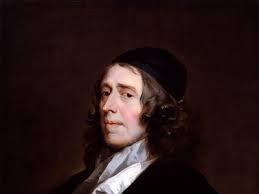
John Owen
John Owen (1616-1683), theologian, was born of Puritan parents at Stadham in Oxfordshire in 1616. At twelve years of age he was admitted at Queen’s College, Oxford, where he took his B.A. degree in 1632 and M.A. in 1635. During these years he worked with such diligence that he allowed himself but four hours sleep a night, and damaged his health by this excessive labour. In 1637 he was driven from Oxford by his refusal to comply with the requirements of Laud’s new statutes. Having taken orders shortly before, he became chaplain and tutor in the family of Sir Robert Dormer of Ascot in Oxfordshire. At the outbreak of the civil troubles he adopted Parliamentary principles, and thus lost both his place and the prospects of succeeding to his uncle’s fortune. For a while he lived in Charterhouse Yard, in great unsettlement of mind on religious questions, which was removed at length by a sermon which he accidently heard at St Michael’s in Wood Street.
His first publication, in 1642, The Display of Arminianism, dedicated to the committee of religion gained him the living of Fordham in Essex, from which a “scandalous minister” had been ejected. Here he was married, and by his marriage he had eleven children.
Although he was thus formally united to Presbyterianism, Owen’s views were originally inclined to those of the Independents, and, as he acquainted himself more fully with the controversy, he became more resolved in that direction, though later he would return to Presbyterianism (as seen in his writings). He represented, in fact, that large class of persons who, falling away from Episcopacy, attached themselves to the very moderate form of Presbyterianism which obtained in England as being that which came first in their way. His views at this time are shown by his Duty of Pastors and People Distinguished. At Fordham he remained until 1646, when, the old incumbent dying, the presentation lapsed to the patron, who gave it to some one else. He was now, however, coming into notice, for on April 29 he preached before the Parliament. In this sermon, and still more in his Thoughts on Church Government, which he appended to it, his tendency to break away from Presbyterianism is displayed.
The people of Coggeshall in Essex now invited him to become their pastor. Here he declared his change by founding a church on Congregational principles, and, in 1647, by publishing Eshcol, as well as various works against Arminianism. He made the friendship of Fairfax while the latter was besieging Colchester, and urgently addressed the army there against religious persecution. He was chosen to preach to Parliament on the day after the execution of Charles, and succeeded in fulfilling his task without mentioning that event, and again on April 19, when he. spake thus:-“The time shall come when the earth shall disclose her slain, and not the simplest heretic shall have his blood unrevenged; neither shall any atonement or expiation be allowed for this blood, while a toe of the image, or a bone of the beast, is left unbroken
No posts found.
No products by this author.